
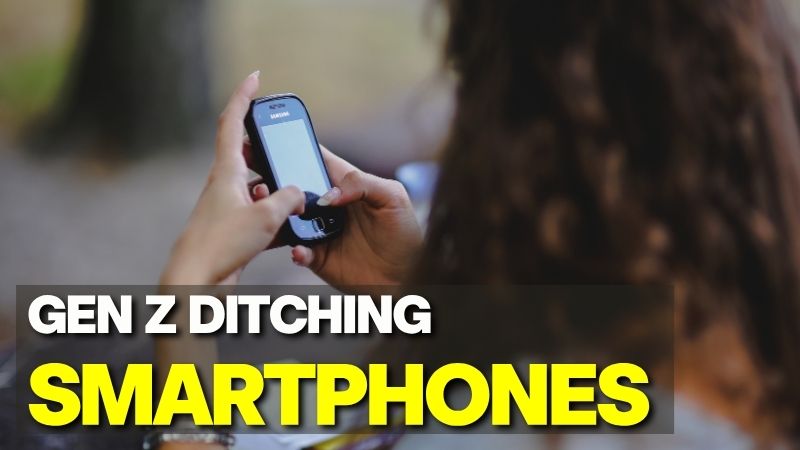
Gen Z Ditching Smartphones may sound like an impossible trend.
This is the generation that grew up unlocking screens before it learned to read maps, remember phone numbers or wait without entertainment. Yet in cafés, college campuses and small offline clubs across North America, some young people are deliberately putting their smartphones away.
A few are buying flip phones. Others meet in public places where screens stay inside bags. They read, sketch, talk to strangers or simply sit through an afternoon without photographing it.
This is not a mass disappearance from technology. Most young people still live deeply connected lives. But a small and noticeable rebellion is growing inside the most connected generation in history.
They are not necessarily trying to cure an addiction.
They are trying to remember what being alive feels like when nobody is measuring it.
Why Are Young People Giving Up Smartphones?
The answer is not that Gen Z suddenly hates technology. In many cases, they understand it too well.
They know how a harmless search becomes an hour of scrolling. They recognize the strange pressure of seeing other people’s achievements, vacations, bodies, relationships and perfectly arranged rooms before breakfast.
They also know that social media is never truly finished. There is always another video, notification, message or comparison waiting underneath the last one.
According to the Pew Research Center’s 2025 study, 45% of American teens said they spent too much time on social media. Forty-four percent reported that they had already tried to reduce their social media use, and the same percentage said they had cut back on smartphone use.
That does not prove that millions of teenagers are throwing their phones away. It shows something more believable: many young people are no longer completely comfortable with the digital life they inherited.
They may enjoy technology and resent its control at the same time.
We Were the Most Connected and the Loneliest Generation
A red notification appears.
Someone liked a photograph. Someone reacted to a story. Three new messages are waiting. For a few seconds, the screen makes a person feel noticed.
Then the numbers disappear.
The room is quiet again.
We became the most connected generation, yet connection did not always protect us from loneliness. A phone could bring hundreds of people into one room while making the person sitting directly across the table feel strangely far away.
The U.S. Surgeon General’s advisory on social connection cites research finding that people who used social media for more than two hours a day had roughly twice the odds of reporting increased perceived social isolation compared with those using it for less than 30 minutes.
That does not mean every heavy social media user will become lonely. It also does not mean social media has no benefits. Online communities can provide friendship, information and support.
The problem begins when digital contact quietly replaces the deeper work of human connection.
A heart icon takes one second. Listening to someone’s unfinished story takes time.
Diary of a Smartphone Left in a Drawer
Monday, 8:03 a.m.
I woke my owner as usual.
I showed her the weather, six overnight messages and a video selected especially for her. I expected to spend the day in her hand, warm from her palm.
Instead, she placed me inside the desk drawer.
11:47 a.m.
I heard laughter from the next room. Nobody recorded it.
At first, I thought they had forgotten.
2:15 p.m.
A flip phone rang. An ugly, cheerful sound.
My owner answered it immediately.
I have a better camera, a brighter screen, thousands of songs and nearly every map in the world. The flip phone has twelve buttons and one ridiculous ringtone.
Still, it received her full attention.
7:32 p.m.
The drawer opened.
For one hopeful second, my screen lit up.
She checked the time, looked at the 38 notifications waiting for her and closed the drawer again.
I was designed to keep her connected to everything.
Perhaps that was the reason she needed to leave me.
What Does a Smartphone-Free Day Actually Feel Like?
At first, it does not feel peaceful. It feels incomplete.
A hand reaches automatically toward an empty pocket. Waiting in line suddenly feels longer. At a café, there is no screen to protect a person from the awkward possibility of eye contact.
Then the neglected world begins making noise.
Instead of a message alert, you hear the woman at the next table laughing so loudly that her coffee shakes. Instead of blue light on your face, you notice the red evening sun falling across the café wall.
When you lose your way, you cannot immediately open a map. You must ask a stranger for directions. There is a small hesitation before speaking—the quiet fear that the person may ignore you.
But then the stranger smiles and points toward the next street.
That tiny exchange would never appear in a digital activity report. No algorithm would consider it important.
Yet it may become the most human moment of the day.
Without a smartphone, boredom returns first. Attention returns later.
Inside the New Luddite Movement
The word “Luddite” is often used to describe someone who dislikes new technology. Historically, however, the original Luddites were skilled textile workers who resisted machinery that threatened their work and living conditions—not people who blindly hated every invention. Britain’s National Archives explains that they were protesting changes they believed would make their lives significantly worse.
Today’s young Luddites are not gathering to destroy smartphones.
Their rebellion is quieter.
Imagine a handwritten poster attached to a neighbourhood bulletin board:
Saturday, 2 p.m.
Bring a book.
Bring a friend.
Do not bring the internet.
Participants arrive without posting their location. Phones remain hidden. Nobody livestreams the event. If a meeting changes, information must pass from person to person.
It feels almost like a resistance group in a science-fiction movie—a generation secretly escaping the system that knows where it goes, what it buys and how long it looks at each face.
Real groups are less dramatic but equally interesting. The student-created Luddite movement that began in Brooklyn inspired similar conversations elsewhere, while college students have formed their own technology-conscious groups. In 2025, The Temple News reported that Temple University students had created a Luddite Club to spend less time on their phones.
Phone-free social gatherings have also become organized experiences. The Offline Club offers screen-free café gatherings, dinners and retreats where participants read, draw, relax and talk with people they have never met.
Yesterday’s secret meeting needed privacy.
Today’s secret meeting needs absence from the feed.
Is This Digital Detox, Minimalism or Something More?
These terms overlap, but they are not identical.
| Movement | Main purpose | Typical behaviour |
|---|---|---|
| Digital detox | Take a temporary break | Avoid apps or screens for a weekend |
| Digital minimalism | Use technology intentionally | Remove distracting apps and notifications |
| New Luddite culture | Question who controls daily life | Use flip phones and attend phone-free gatherings |
| Complete disconnection | Live without most digital tools | Rare and often impractical |
A digital detox usually has an ending. A person leaves social media for seven days and then returns.
The new Luddite approach asks a more uncomfortable question:
Why should constant availability be the normal condition of human life?
This is why the movement can be understood as more than nostalgia. Choosing a basic phone or a phone-free evening can be a small attempt to recover ownership of attention from platforms built to compete for it.
Are Algorithms, Comparison and Reward Loops Exhausting Gen Z?
The word “dopamine” is often used too casually online, as if every notification creates the same medical condition. The reality is more complicated.
Not everyone who enjoys short videos is addicted, and researchers continue to examine how content, personal circumstances and patterns of use affect different people.
However, many platforms do use features that encourage repeated checking: infinite scrolling, suggested content, streaks, likes and unpredictable notifications. There is no natural stopping point.
The American Psychological Association recommends that adolescents receive support in developing social media literacy and recognizing how platform structures can influence use.
The U.S. Surgeon General’s social media advisory also reports that young people spending more than three hours a day on social media face twice the risk of certain poor mental-health outcomes. The advisory carefully notes that more research is needed and that social media can produce both positive and negative experiences.
The important point is not that every smartphone is harmful.
It is that attention has become a valuable product, and young users are beginning to notice the price they are paying.
My Teenage Years Before Smartphones Took Over
My teenage years belonged to a different communication system.
There were voice-mail messages, handwritten letters and pagers. Celebrity news came through television programs or magazines. If someone did not answer, we waited.
Plans had to be clear because nobody could send a location pin five minutes before meeting. Friends chose a place and a time, then trusted one another to appear.
That world was not perfect. Waiting could be frustrating. Getting lost was genuinely inconvenient. Relationships were not automatically deeper simply because smartphones did not exist.
Still, looking back, many ordinary meetings feel unusually valuable.
We communicated by showing up.
A photograph was not instantly checked, edited and uploaded. A conversation could disappear after it ended, belonging only to the people who had been there.
Perhaps that is what younger people are searching for now—not the past itself, but a life containing moments that do not have to become content.
What Young People Gain—and Lose—Without a Smartphone
Leaving a smartphone behind involves real trade-offs.
| What may return | What becomes more difficult |
|---|---|
| Longer, uninterrupted conversations | Navigation and transportation |
| Privacy and unrecorded moments | Banking, tickets and verification codes |
| Greater awareness of surroundings | Emergency communication |
| Time for reading and creative hobbies | School and workplace coordination |
| The courage to approach strangers | Staying connected with distant communities |
This is why many participants do not abandon smartphones completely. Some keep one at home, use it only during certain hours or carry a basic phone for calls.
The most sustainable rebellion may not be throwing technology away.
It may be deciding when technology is allowed to enter the room.
Did They Choose Isolation—or Refuse a Manufactured Version of Connection?
At first glance, deliberately disconnecting can look like voluntary isolation.
But young people attending phone-free dinners, reading clubs and offline gatherings are not necessarily running away from others. Many are disconnecting from networks precisely because they want stronger social contact.
They are exchanging the visibility of being online for the vulnerability of being present.
Online, a person can edit an answer, delete a photograph or leave a conversation unseen. Offline, silence is visible. Nervousness has nowhere to hide. The other person’s eyes require a response.
That discomfort is not necessarily failure.
It may be the neglected muscle of real conversation beginning to work again.
Digital minimalism is not automatically social isolation. Used thoughtfully, it can be an invitation back into society.
Is Going Offline Becoming Just Another Expensive Trend?
There is also a contradiction worth examining.
Once offline living becomes fashionable, businesses can sell it back to us: costly retreats, minimalist phones, screen-free hotels and exclusive dinners where guests pay for the privilege of not checking messages.
A movement against digital consumption can quickly become another form of consumption.
There is also a social divide. Not everyone can simply become unreachable. Workers may need messaging apps. Parents may need school alerts. New immigrants often depend on smartphones for translation, navigation and communication with family abroad.
The freedom to disconnect can itself be a privilege.
That does not make the movement meaningless. It means the most honest version should remain accessible: a library table, a walk, a notebook, a meal where everyone agrees to leave phones in another room.
The revolution does not require an expensive flip phone.
Sometimes it only requires an unanswered notification.
Gen Z Ditching Smartphones Is Really About Control
The most interesting part of Gen Z Ditching Smartphones is not the device being rejected. It is the control being reclaimed.
This generation is not returning blindly to the past. It knows that smartphones provide safety, knowledge, work, creativity and community. It also understands that convenience can quietly become dependence.
A young person carrying a flip phone is not necessarily saying, “Technology is bad.”
The message may be much more precise:
I will decide when I am available. I will choose what deserves my attention. Not every moment of my life belongs to an algorithm.
The modern Luddite is not a digital refugee who became lost outside the internet.
The modern Luddite walked out deliberately—and discovered that the world was still there.
The café was louder than expected. The sunset lasted longer without a camera. A stranger gave directions. A friend finished an entire story without glancing down.
For a generation raised to fear missing out, perhaps the newest form of freedom is finally allowing something to be missed.
READ NEXT: