
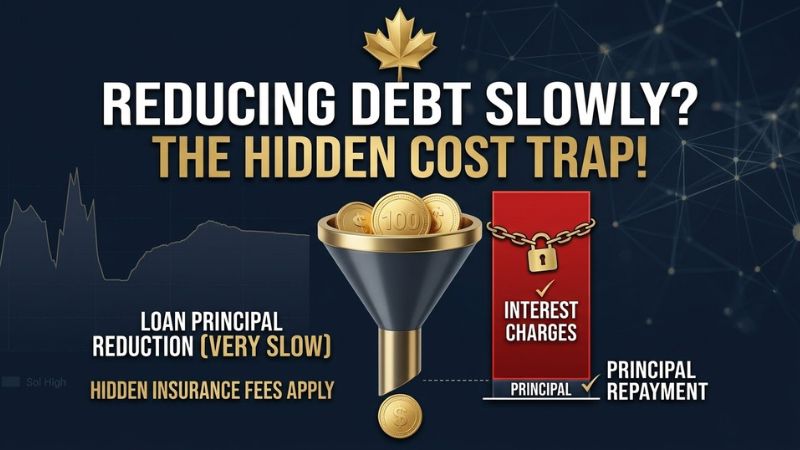
Loan insurance in Canada is one of those financial details that can easily disappear into the paperwork—until someone notices that their loan balance has barely moved.
Imagine borrowing $4,000 to cover an unexpected expense. You make your payments every month, never miss a due date, and assume you’re gradually getting back on your feet.
Two years later, you check your balance.
You still owe nearly $4,000.
How is that even possible?
For many newcomers, moving to Canada already comes with a long list of financial surprises. There’s the rental deposit, transportation, winter clothing, higher-than-expected grocery bills, and the challenge of building a Canadian credit history from scratch.
Sometimes, borrowing money feels less like a choice and more like the only way to get through a difficult month.
But here’s where things can get expensive: the cost of borrowing can become much bigger than the original problem you were trying to solve.
A relatively small loan may come with interest, insurance premiums, and other charges that quietly add up over several years.
The good news? Once you understand how these charges work, you can start asking better questions—and avoid paying for things you may not need.
A $4,000 Loan That Reportedly Cost $12,000
In October 2026, a Canadian news report highlighted the experience of a borrower who claimed to have paid approximately $12,000 over six years on an original $4,000 personal loan.
According to the borrower’s account shared online, the loan was taken out in 2020 after a job loss during the COVID-19 pandemic.
After two years of making payments, the borrower reportedly discovered that the remaining balance was still close to the original amount.
There was another surprise: loan insurance charges the borrower did not remember agreeing to.
The story attracted attention because of the enormous difference between the amount borrowed and the amount reportedly paid.
However, the account has important limitations. The full loan agreement and payment records have not been independently verified, and the exact amounts attributed to interest, insurance, and other charges remain unclear. It would be unfair to treat the story as proof of wrongdoing by the lender.
Still, the situation raises a question worth asking:
If you keep paying your loan, where is all that money actually going?
That’s something every borrower should understand, whether they’ve lived in Canada for twenty years or arrived twenty days ago.
Why Your Loan Balance May Barely Go Down
Here’s the part that often catches borrowers off guard.
Your monthly payment is not the same thing as your monthly debt reduction.
When you pay $200 toward a loan, that doesn’t necessarily mean you owe $200 less afterward.
Your payment may cover several different costs.
Where does your monthly payment go?
Let’s imagine a hypothetical monthly payment breakdown:
| Payment component | Amount |
|---|---|
| Principal repayment | $80 |
| Interest | $85 |
| Optional loan insurance | $35 |
| Total paid | $200 |
This is an illustrative breakdown, not an actual loan offer. Insurance may be charged separately rather than included in a scheduled payment.
In this example, $200 leaves your bank account, but only $80 reduces the original debt.
The rest pays for borrowing the money and maintaining the insurance coverage.
That’s not automatically suspicious. Interest is a normal part of most loans.
With many fixed-payment installment loans, a larger share of early payments goes toward interest because the outstanding balance is higher. As the balance falls, the interest portion generally decreases.
The problem begins when borrowers don’t understand the arrangement—or when additional charges make the loan significantly more expensive than expected.
Why can the problem continue for years?
Several things can slow repayment:
- High interest rates: More of each payment goes toward interest.
- Long repayment terms: Smaller monthly payments may mean substantially more interest overall.
- Optional insurance: Premiums add to the cost of maintaining the loan.
- Late fees: Missed payments can create additional charges.
- Refinancing or loan top-ups: Borrowing more or restarting a repayment schedule can extend the debt.
If someone has made every scheduled payment for two years and their principal has barely decreased, they should request a detailed repayment breakdown.
It may have a legitimate explanation, but it deserves a closer look.
Is Loan Protection Insurance Mandatory in Canada?
This is one of the most important questions to ask before signing a personal loan agreement.
Generally, creditor loan insurance is optional.
It may be offered alongside a loan to help cover payments or outstanding debt if certain unexpected events occur.
Depending on the policy, these events may include:
- Job loss
- Disability or injury
- Critical illness
- Death
That sounds reassuring, especially when you’re already worried about money.
But an insurance policy is only useful if it covers the situations you’re actually likely to face.
For example, a job-loss insurance policy may have eligibility requirements relating to employment status, waiting periods, or other conditions.
Someone working on short-term contracts, working part-time, or running a small business should examine those conditions particularly carefully.
You don’t want to discover after losing your income that your situation was never covered.
What if you never agreed to buy the insurance?
The Financial Consumer Agency of Canada (FCAC) states that federally regulated financial institutions must obtain a customer’s express consent before providing optional loan insurance.
Banks must also enter into a separate agreement for the insurance.
In plain English, agreeing to borrow money is not automatically the same as agreeing to buy additional insurance.
These specific federal consent protections apply to federally regulated institutions such as banks and federal credit unions. Non-bank lenders may be subject to different provincial requirements.
You can read the government’s explanation here: Financial Consumer Agency of Canada – Loan Insurance: Know Your Rights.
One more thing: optional creditor insurance is different from certain other insurance arrangements, such as mortgage default insurance. Don’t assume every type of insurance connected to borrowing follows the same rules.
When Small Insurance Payments Become a Big Expense
A $30 monthly charge may not seem like much.
That’s sometimes why people overlook it.
But consider the long-term cost.
| Monthly insurance premium | 3 years | 5 years | 6 years |
|---|---|---|---|
| $20 | $720 | $1,200 | $1,440 |
| $30 | $1,080 | $1,800 | $2,160 |
| $40 | $1,440 | $2,400 | $2,880 |
These figures assume the same premium is charged every month, without additional financing costs.
Now imagine paying $40 every month for six years.
That’s $2,880 in premiums alone.
And that’s before counting the interest on the loan.
A small charge doesn’t stay small simply because it’s collected in small pieces.
This doesn’t mean loan insurance is always a bad purchase. Some borrowers genuinely need the protection.
But there’s a difference between choosing a useful safety net and unknowingly paying for one.
Before buying coverage, check whether you already have similar protection through your employer, life insurance, disability insurance, or another existing policy.
Paying twice for overlapping benefits may not provide twice the protection.
AIR vs. APR: Two Numbers That Can Change Everything
Two financial abbreviations appear frequently in Canadian loan agreements:
AIR (Annual Interest Rate) and APR (Annual Percentage Rate).
They sound almost identical, but they are not necessarily the same.
AIR: The cost of interest
AIR describes the annual interest rate charged on the borrowed money.
For example, a loan might advertise an annual interest rate of 20%.
But that number alone doesn’t necessarily tell you about additional borrowing fees.
APR: The broader cost of borrowing
APR includes interest and certain additional costs that must be included under the applicable rules.
It’s designed to help borrowers compare the cost of credit more meaningfully.
However, you should still ask which expenses are included in the displayed APR and whether optional insurance premiums are charged separately.
What to compare before signing
| What you see | What you should ask |
|---|---|
| Low monthly payment | How many months will I pay? |
| Advertised interest rate | What is the APR? |
| Optional insurance | How much will the premiums cost in total? |
| Loan amount | How much money will I actually receive? |
| Payment schedule | What is the full amount I’ll repay? |
| Early repayment option | Will I pay a penalty to finish early? |
The most useful number isn’t necessarily the one printed in the biggest font.
It’s the total amount you will have paid when the debt is finally gone.
For more guidance, see the federal government’s Personal Loans: Costs, Terms and Borrower Information.
How Much Does a $4,000 Personal Loan Really Cost?
Let’s put some real numbers beside the explanation.
Suppose someone borrows $4,000 and repays it over three years.
We’ll compare three hypothetical fixed interest rates, assuming 36 equal monthly payments and no insurance or extra fees.
| Annual interest rate | Monthly payment | Total repayment | Total interest |
|---|---|---|---|
| 10% | $129.07 | $4,646 | $646 |
| 20% | $148.65 | $5,352 | $1,352 |
| 25% | $159.04 | $5,725 | $1,725 |
Figures are rounded and calculated using a nominal annual interest rate with monthly repayment. They are educational examples, not APR quotations or actual lender offers.
Notice what happens.
At 10% interest, the borrower pays approximately $646 in interest over three years.
At 25%, that increases to approximately $1,725.
That’s nearly $1,080 more in interest for borrowing exactly the same amount of money.
Now add an optional $30 monthly insurance premium for 36 months.
That’s another $1,080.
The combined amount paid under the 25% example would rise to approximately $6,805.
A $4,000 loan has now become a $6,805 expense.
The extra costs have grown to about 70% of the original amount borrowed.
And if the borrower extends the repayment period further, the total interest cost can increase again.
This is why a lender’s promise of “affordable monthly payments” should never be the end of the conversation.
Affordable today and inexpensive overall are two completely different things.
Canada’s 35% Interest Rate Rule: What Changed in 2025?
Canada introduced an important change to its criminal interest rate rules on January 1, 2025.
For most covered loans, the criminal interest rate threshold was reduced from the equivalent of approximately 48% APR to 35% APR.
The change was intended to strengthen protections against excessively expensive lending.
But there’s an important detail.
The 35% threshold does not apply in exactly the same way to every type of credit arrangement.
Certain exemptions exist, including rules for qualifying payday loans and some commercial lending arrangements.
Loans entered into before the new rules took effect may also be treated differently.
For that reason, a borrower with an older loan should not automatically assume their existing rate became illegal in January 2025.
The original contract date and loan type matter.
The federal government’s policy explanation is available in Canada’s 2024 Fall Economic Statement – Reducing Everyday Costs.
Does a legal interest rate mean it’s a good deal?
Not necessarily.
A loan can comply with the law and still be extremely expensive.
Legal maximums are not recommendations for what borrowers should pay.
It’s possible to borrow at a permitted rate and still end up spending far more than expected.
That’s why comparing offers remains essential.
Living in British Columbia? Extra High-Cost Loan Protections May Apply
Canada has federal lending rules, but provinces and territories also regulate certain consumer credit products.
British Columbia offers a useful example.
In BC, certain personal, family, or household credit products with an APR above 32% fall under provincial high-cost credit rules.
These rules can apply to eligible installment loans, lines of credit, and certain leases. Banks and credit unions are generally exempt from BC’s high-cost credit licensing regime, and payday loans have separate rules.
For covered high-cost credit agreements, several consumer protections are especially important.
1. You may have a short cancellation period
Consumers generally have the right to cancel a covered high-cost credit agreement before the end of the next business day.
The borrowed funds still need to be returned according to the cancellation requirements, but the lender cannot simply impose a cancellation fee for exercising that right.
Additional cancellation rights may apply in certain circumstances.
2. Optional products cannot be forced on you
A covered high-cost lender cannot make the purchase of optional insurance or other optional products a condition of entering the loan agreement.
3. Early repayment fees are prohibited
Under BC’s covered high-cost credit rules, lenders cannot charge a fee for making early payments.
4. Important loan costs must be disclosed
Covered agreements must contain required information about payment amounts, interest rates, fees, optional credit products, and the total cost of credit.
These rules are particularly valuable for anyone who feels rushed into a contract.
You can check the details through Consumer Protection BC – High-Cost Credit Products.
Important: These are BC-specific protections for qualifying products. Borrowers in Ontario, Alberta, Quebec, or other provinces should check the rules that apply where they live.
Already Paying a Loan? Check These Six Things
Maybe you signed your loan agreement months ago.
Maybe it’s been two years.
And maybe the paperwork is sitting in an email folder you haven’t opened since the day you borrowed the money.
That’s a good place to start.
1. Find your original agreement
Search your email or account records for terms such as:
- Loan Agreement
- Credit Agreement
- Disclosure Statement
- Repayment Schedule
- Certificate of Insurance
Don’t rely only on your banking app’s monthly withdrawal amount.
2. Check your outstanding principal
Look for Outstanding Principal or Principal Balance.
This is the amount of the original debt that remains unpaid, before any other amounts that may be due.
Compare it with the amount you originally borrowed.
3. Search for insurance charges
Loan insurance in Canada may appear in agreements under several different names, including:
- Creditor Insurance
- Loan Protection Insurance
- Credit Protection
- Balance Protection Insurance
- Debt Insurance
Finding one of these terms doesn’t automatically mean something is wrong.
It means you should check whether you agreed to the coverage and how much you’re paying for it.
4. Ask for a full payment breakdown
Request a record showing how every payment has been allocated.
You want to see how much went toward principal, interest, insurance, and other fees.
If the totals don’t make sense, request an explanation in writing.
5. Ask for today’s payoff amount
The amount required to close the loan today may be different from the sum of all remaining scheduled payments.
Ask the lender for a written payout statement.
6. Review the cost of keeping the loan
Look at what happens if you continue with the existing payment schedule.
Then compare that amount with the options available for early repayment or refinancing.
Be careful: refinancing isn’t automatically a bargain. Extending the term or adding new charges can make a seemingly cheaper monthly payment more expensive overall.
What If You Don’t Remember Agreeing to Loan Insurance?
First, don’t panic.
Not remembering an insurance agreement isn’t necessarily proof that the lender enrolled you without permission.
But you absolutely have a reason to ask questions.
Start by requesting copies of the original loan agreement, insurance certificate, enrollment record, and complete payment history.
Then ask how your consent was obtained.
If you believe insurance was added without authorization, ask the lender and insurer to review the enrollment, explain the charges, and assess whether cancellation or a refund is appropriate.
A simple message you can send your lender
Hello,
I am reviewing my loan account and noticed charges that appear to be related to loan insurance.
Could you please provide a copy of my insurance agreement, proof of my enrollment or consent, and a complete payment history showing how my payments have been allocated?
I would also like to know whether I can cancel the insurance and whether any refund may be available.
Please respond in writing so I can keep a record of the information.
Thank you.
You don’t need to use complicated financial language.
You just need clear answers.
What if the lender doesn’t resolve the issue?
If the lender is a federally regulated bank or federal credit union, use its formal complaint-handling process.
For a non-bank lender, check the applicable provincial consumer protection authority or insurance complaint process.
Keep copies of emails, statements, contracts, and responses.
And one important warning: do not assume that cancelling your automatic payments cancels your loan.
Stopping payments without an agreed arrangement can lead to missed-payment consequences and potentially damage your credit record.
Dispute questionable charges through the appropriate process while making sure you understand your ongoing repayment obligations.
Why Newcomers Can Be Especially Vulnerable to Expensive Loans
One of the frustrating parts of moving to a new country is that financial stability doesn’t always travel with you.
Someone may have spent fifteen years working, managing bills, and maintaining excellent credit in another country.
Then they arrive in Canada and discover that local lenders have very little Canadian credit history to evaluate.
Experience with money and a Canadian credit score are not the same thing.
Newcomers may also face irregular employment, unexpected settlement expenses, unfamiliar financial terminology, and pressure to make quick decisions.
For someone worried about next month’s rent, a fast loan approval can feel like a lifeline.
That’s understandable.
But urgency is precisely when it’s easiest to overlook the fine print.
And let’s be fair: this isn’t only an immigrant problem. Anyone can struggle to understand the true cost of borrowing.
The difference is that newcomers may be learning an entirely new financial system at the same time.
A person shouldn’t need to become a financial expert just to understand how much a $4,000 loan will cost.
Yet knowing a few basic questions can make a remarkable difference.
Before Taking an Expensive Loan, Explore Other Options
A high-cost lender isn’t necessarily the only option.
Before accepting an expensive personal loan, consider whether you qualify for a lower-cost product from a bank or credit union.
Some people may also benefit from speaking with their existing financial institution about payment arrangements, a small personal line of credit, or other available credit options.
If you’re struggling with multiple debts, a reputable credit counsellor may help you review your budget and possible repayment solutions.
Credit counselling can include financial education, individualized advice, and debt management plans.
But be cautious about companies promising to erase debt instantly or repair your credit score overnight.
Some services charge substantial fees, and not every repayment program is suitable for every situation.
The federal government provides guidance on choosing a trustworthy organization through Getting Help from a Credit Counsellor.
Also remember that not all counselling services are free. Ask about consultation charges, program fees, and expected outcomes before committing.
The goal isn’t simply to replace one loan with another. It’s to find a way out that doesn’t create an even bigger problem.
Frequently Asked Questions About Personal Loans in Canada
Can I get a personal loan with little or no Canadian credit history?
Possibly. Approval depends on the lender’s requirements, your income, existing debts, credit profile, and other circumstances.
Some lenders work with applicants who have limited credit histories, but this does not guarantee approval or favourable terms.
Compare the full borrowing cost instead of choosing a lender solely because it advertises easy approval.
Can I cancel loan insurance without cancelling the loan?
In many cases, optional creditor insurance can be cancelled separately from the underlying loan.
However, cancellation procedures, effective dates, and refund rights depend on the policy and applicable rules.
Ask for confirmation in writing.
Will I get all my insurance premiums back if I cancel?
Not automatically.
Refund eligibility depends on the contract, how premiums were charged, the reason for cancellation, and whether the insurance was properly authorized.
Some situations may allow a refund or adjustment, but you should not assume the entire amount paid will be returned.
Does paying off a loan early save money?
Often, yes.
Early repayment can reduce future interest charges. However, the exact savings depend on the loan structure, repayment terms, and any applicable fees.
Ask for a written payout quote before deciding.
Are payday loans and personal installment loans the same thing?
No.
Payday loans are typically short-term borrowing products with different repayment structures and specific regulatory rules.
Personal installment loans are generally repaid through scheduled payments over a longer period.
Do not assume that the same interest rate limits, fees, or consumer protections apply to both products.
What if my loan payments are becoming impossible to manage?
Contact your lender before missing payments, if possible, and ask whether a repayment arrangement is available.
You can also consult a reputable credit counsellor.
If the debt is severe, you may need information about formal solutions such as consumer proposals or bankruptcy from a Licensed Insolvency Trustee.
These options have different consequences, so professional advice may be helpful.
The Real Price of a Loan Isn’t Always on the First Page
Moving to a new country takes courage, patience, and money.
Sometimes it also takes a little borrowed money.
There is no reason to judge someone for needing financial help during a difficult period.
The danger isn’t simply borrowing. It’s borrowing without knowing what the agreement will cost you in the end.
A $30 insurance charge might appear insignificant beside rent, utilities, and groceries.
A slightly lower monthly payment may look like a welcome relief.
But over several years, those seemingly small details can become hundreds or thousands of dollars.
That’s when the extras start costing almost as much as the original loan.
Before signing anything, ask yourself three questions:
How much money am I actually receiving?
How much will I pay back in total?
Am I paying for insurance or other services I don’t really need?
If you already have a loan, it’s not too late to check those answers.
Pull out the agreement. Look at the numbers. Ask for a breakdown. Challenge anything that doesn’t make sense.
And if the explanation sounds too complicated, ask the lender to put it in simpler language.
You have every reason to understand a financial commitment that may follow you for years.
A loan should help you cross a difficult financial stretch—not turn a temporary problem into a long-term burden.
The more clearly you understand the price of borrowing, the better prepared you’ll be to protect the life you’re building in Canada.
Editorial note: This article provides general financial information based on publicly available Canadian government and provincial consumer protection guidance. It is not individualized financial or legal advice. The loan calculations are illustrative. Consumer rights may vary by province, lender type, loan agreement, and contract date.
Rean next: