
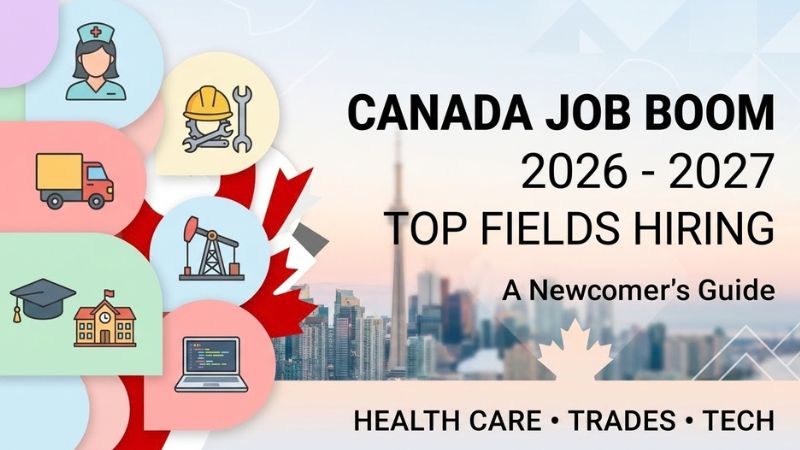
Jobs in Demand in Canada 2026–2027 are not concentrated in one shiny new industry, and Canada is not experiencing the same hiring conditions everywhere.
That distinction matters.
A nurse looking for work in British Columbia is entering a very different labour market from a software developer in Toronto. A construction worker in Alberta faces different opportunities again. Even two people with similar résumés can have very different outcomes depending on province, licensing, local demand, Canadian certification and the exact occupation they choose.
So instead of asking, “What is the hottest job in Canada?” a more useful question for 2026 and 2027 is:
Where is Canada still struggling to find workers — and how realistic is it for a newcomer to enter those jobs?
Canada’s Job Bank currently publishes three-year employment outlooks for occupations by province and economic region. The outlooks range from Very Good to Very Limited, and the federal government specifically warns that an occupation can have different prospects from one part of Canada to another.
You can explore the official regional outlooks through Canada’s Job Bank employment outlooks.
That makes the picture more complicated than a “Top 10 Jobs” headline — but also much more useful.
The Big Picture: Canada Still Has Labour Gaps, but Not Everywhere
Canada’s labour market in 2026 is not a single national hiring boom.
Some occupations remain difficult for employers to fill. Others are closer to balance. A few have more available workers than projected openings.
Employment and Social Development Canada’s Canadian Occupational Projection System, or COPS, projects that more than 100 occupations could face a moderate or strong risk of labour shortages over the 2024–2033 period.
Health occupations stand out.
Federal projections estimate average annual employment growth of about 2.5% for health occupations between 2024 and 2033, higher than the broad occupational categories listed in the same federal projection. Trades, transport and equipment occupations are also expected to see substantial hiring needs, including jobs created by worker replacement and retirement.
The broader projection data can be explored through Canada’s Occupational Projection System (COPS).
But numbers are only the first part of the story.
A shortage does not automatically mean an easy job offer.
That is especially important for newcomers.
1. Health Care and Social Assistance: Canada’s Clearest Demand Story
If there is one sector that consistently appears near the top of Canada’s labour-demand conversation, it is health care and social assistance.
Job Bank describes health care and social assistance occupations as among the country’s most in-demand areas, covering everything from medical care to residential support, counselling, community services and childcare.
The demand is also much broader than doctors and registered nurses.
Depending on the region, opportunities can include:
- registered nurses
- licensed practical nurses
- nurse aides
- personal support workers
- home support workers
- medical technologists
- paramedical occupations
- social and community service workers
- care-home staff
Federal long-term projections classify home support workers and caregivers as facing a strong risk of shortage nationally over 2024–2033.
The newcomer catch: demand can be high while entry is difficult
A doctor with ten years of overseas experience cannot necessarily begin practising immediately after arriving in Canada.
The same issue can affect nurses, pharmacists and other regulated health professionals.
Canada requires internationally trained workers in many regulated occupations to have their education, training and professional experience recognized and, where required, obtain provincial or territorial licensing.
That process can take time.
So health care may offer some of Canada’s strongest long-term demand, but its newcomer entry barrier ranges from relatively accessible to extremely high, depending on the occupation.
2. Construction and Skilled Trades: Quietly Becoming One of the Most Practical Career Paths
A tower crane on the Vancouver skyline does not look like an immigration statistic.
But it tells you something.
Canada needs people who can actually build, install, repair and maintain the infrastructure behind population growth.
Construction and skilled trades can include:
- carpenters
- electricians
- plumbers
- welders
- heavy-duty equipment technicians
- millwrights
- HVAC technicians
- construction labourers
- pipefitters
- industrial mechanics
Federal projections currently place carpenters among occupations facing a strong national risk of shortage over the 2024–2033 projection period. Construction millwrights and industrial mechanics are projected to face a moderate risk of shortage.
This is also where Canada’s large infrastructure and energy projects become relevant.
Pipelines, transit expansions, housing construction, electrical upgrades, industrial facilities and energy infrastructure do not create only engineering positions.
They can also create demand across construction, maintenance, transportation, safety, procurement and supply chains.
That is why projects such as the Pacific Link proposal are worth watching beyond the energy headlines themselves.
Internal link suggestion:
Pacific Link vs. Trans Mountain: What Canada’s Next Energy Corridor Could Mean
Do you need Canadian certification?
Sometimes.
Canada has more than 300 trades designated by provinces and territories, and certification rules are not identical across the country. Many major trades participate in the Red Seal system, which establishes common standards and examinations across participating jurisdictions.
Anyone considering this route should check the official Red Seal trades and certification information before assuming overseas experience transfers automatically.
3. Transportation and Logistics: The Jobs Behind Everything Else
A new hospital needs supplies.
A construction project needs materials.
A grocery store needs deliveries.
An online order needs a warehouse, sorting system and final-mile route.
That is why transportation and logistics sit quietly behind almost every other growing industry.
Potential occupations include:
- truck and transport mechanics
- transport truck drivers
- dispatchers
- warehouse supervisors
- logistics coordinators
- supply-chain staff
- material handlers
- equipment operators
For newcomers, this field can be especially interesting because the entry barriers vary widely.
A logistics coordinator may rely mainly on relevant experience, software skills and communication ability. A commercial driver may need a provincial licence. A transport mechanic may enter through an apprenticeship or certification pathway.
In other words, “transportation” is not one job market.
It contains both relatively accessible occupations and highly regulated skilled careers.
4. Energy and Major Infrastructure: More Than Oil and Gas Jobs
When people hear “energy jobs in Canada,” many immediately think of Alberta oilfields.
That picture is too narrow.
Canada’s energy and infrastructure economy includes:
- conventional energy
- electricity transmission
- hydroelectric power
- LNG-related development
- pipeline infrastructure
- renewable projects
- engineering
- environmental services
- construction
- industrial maintenance
- project management
And major projects create secondary demand.
A large infrastructure project may need engineers, but it may also need welders, equipment technicians, safety staff, drivers, administrators, environmental specialists and procurement workers.
This is the connection between our earlier discussion of Pacific Link and Trans Mountain and the labour market.
The headline may be about a pipeline.
The employment story is much wider.
Who should watch this field?
This sector may be particularly relevant for people with previous experience in:
engineering, trades, construction, industrial maintenance, heavy equipment, safety, logistics or project coordination.
The biggest limitation is that hiring can be project-driven. A large announcement does not mean thousands of permanent positions appear immediately.
For job seekers, watching actual projects, contractor hiring and regional Job Bank outlooks is more useful than watching political announcements alone.
5. Education and Childcare: Demand That Follows Population
More people do not simply require more homes and hospitals.
They also require classrooms, childcare spaces and community services.
That creates opportunities in fields such as:
- early childhood education
- childcare assistance
- educational support
- community services
- specialized teaching
- school support roles
Entry requirements differ significantly by province and role.
Early childhood educators, for example, may need provincial certification, while some support positions have different requirements.
This sector can therefore be a good example of a middle-barrier career: more preparation than an entry-level service job, but potentially a shorter pathway than retraining for a highly regulated profession.
6. Technology: Still Attractive, but Choose the Occupation Carefully
Technology deserves to be on this list — but with an asterisk.
The days when it was useful to say simply “learn coding because Canada needs tech workers” are gone.
Tech hiring has become more selective.
Different occupations can face very different conditions, and even the federal long-term projections show that not every technology-related role is moving in the same direction. For example, COPS identifies some information-technology occupations differently from the broader natural and applied sciences category.
Areas worth researching individually include:
- cybersecurity
- cloud infrastructure
- software engineering
- data engineering
- AI-related technical roles
- business systems
- enterprise software
- specialized technical support
The key word is specialized.
A newcomer with deep experience in a particular platform, industry or technical stack may have a very different job search from someone competing for a broad junior role.
So do not choose “tech.”
Choose an occupation.
Then check that occupation in the province where you actually plan to live.
7. Hospitality and Service Work: Accessible Does Not Always Mean Easy
Restaurants, hotels, retail operations and service businesses continue to employ huge numbers of Canadians and newcomers.
These jobs can matter for a different reason.
They may provide one of the faster ways to gain:
- local references
- workplace English experience
- Canadian customer-service experience
- a first Canadian employer
- income while retraining
But there is an important distinction.
A job can be easier to enter without being a stronger long-term career market.
Some service occupations have high turnover but relatively modest wages. Others may offer management or specialized career paths.
The right question is not simply:
“Can I get this job?”
It is:
“Where can this job take me next?”
Which Industries Look Most Practical for Newcomers?
| Industry | Demand Signal | Newcomer Entry Barrier | Canadian Licence? | Practical Take |
|---|---|---|---|---|
| Health care | Very strong in many roles | Medium–High | Often | Excellent demand, but check licensing first |
| Construction & trades | Strong for selected trades | Medium | Sometimes | Strong option for hands-on experience |
| Transportation & logistics | Varies by occupation/region | Low–Medium | Role dependent | Several accessible entry points |
| Energy & infrastructure | Project-driven | Medium | Role dependent | Good for trades and industrial experience |
| Education & childcare | Strong in many communities | Medium | Often role/province dependent | Worth checking provincial certification |
| Technology | Highly occupation-specific | Medium | Usually no professional licence | Specialization matters more than “tech” broadly |
| Hospitality & service | Local and seasonal variation | Low | Usually no | Useful entry point, but plan the next step |
Important: This table is a practical comparison, not a guarantee of employment. Job Bank specifically advises that employment prospects vary by occupation, province and economic region.
Beyond the Numbers: The Part of the Story Statistics Miss
Beyond the Numbers Are Real People
Labour-market tables make careers look strangely neat.
Strong outlook. Moderate outlook. Labour shortage. Job opening.
But for a newcomer, those words rarely feel neat.
Behind them may be a résumé rewritten three times because the first version felt “too Korean,” “too Indian,” “too Brazilian,” or simply not Canadian enough.
There may be years of professional experience that suddenly need explaining again.
There is sometimes that uncomfortable pause when an interviewer asks, “Do you have Canadian experience?”
And there are people serving coffee, stocking supermarket shelves or driving deliveries at night while studying for an exam that could eventually reopen the career they once had.
Those jobs are easy to dismiss as temporary.
They should not be.
For many immigrants, settlement does not move in a straight line from arrival → dream job → success.
It looks more like:
arrival → survival job → English → certification → networking → rejection → another application → first opportunity → a better opportunity.
What matters is not pretending that yesterday’s career disappears.
Nor is it clinging so tightly to an old job title that every other route feels like failure.
Sometimes building a career in Canada means learning how to translate what you already know into something the Canadian labour market understands.
A temporary step is not necessarily a step backward. Sometimes it is the bridge.
The Biggest Mistake: Confusing “In Demand” With “Easy to Enter”
This may be the single most important point in this entire guide.
Imagine two occupations.
Occupation A has an enormous worker shortage but requires Canadian licensing, examinations and supervised practice.
Occupation B has more moderate demand but allows an employer to hire you immediately based on your experience.
Which one gives a newcomer the faster path to employment?
Possibly Occupation B.
That is why newcomers should evaluate careers using two separate questions:
1. Does Canada need workers in this occupation?
2. What must I personally do before an employer can legally and realistically hire me?
The second question is often neglected.
Check Whether Your Profession Is Regulated Before You Retrain
If your occupation is regulated, start here before spending money on another diploma.
Canada’s Foreign Credential Recognition system explains that internationally trained workers in regulated professions or compulsory trades may need their credentials assessed and must meet the licensing or certification requirements of the province or territory where they intend to work.
You can begin with the federal government’s official Foreign Credential Recognition information.
This can save months of confusion.
An Educational Credential Assessment used for immigration, for example, is not the same thing as professional licensing.
A degree being recognized as equivalent to a Canadian degree does not automatically give someone permission to practise a regulated profession.
Before Paying for Another Course, Do These Five Things
1. Search the exact occupation, not just the industry
Do not search only “health care jobs.”
Search:
Licensed Practical Nurse — British Columbia
or
Construction Electrician — Alberta
Specific searches produce useful information.
Industry-level searches produce inspiration.
You need both, but they are not the same thing.
2. Compare provinces
The same occupation can have different prospects in Vancouver, Calgary, Toronto, Winnipeg or Halifax.
Job Bank explicitly notes that its rankings are regional and should not be treated as nationally comparable scores.
Moving provinces is not realistic for everyone.
But if you are flexible, geography can become part of your career strategy.
3. Identify the licensing gap
Write down:
What I already have → What Canada requires → What is missing
For example:
Overseas experience + foreign qualification
→ Canadian credential assessment
→ provincial registration
→ exam or supervised practice
→ eligibility to work
Seeing the gap on one page makes the process much less overwhelming.
4. Build a Canadian-style résumé around results
Do not simply translate your old résumé word for word.
Canadian employers usually need to understand quickly:
- what you did
- what tools you used
- what responsibility you held
- what measurable result you produced
- how your experience relates to this particular vacancy
“Ten years of experience” sounds impressive.
“Managed purchasing for 14 suppliers and reduced delivery delays by 18%” gives an employer something concrete to picture.
Eligible newcomers can also explore federal pre-arrival employment services that provide help with résumés, interviews, networking and credential-recognition pathways.
See the official Government of Canada pre-arrival employment services.
5. Look for the job beside your old job
This strategy is underrated.
An internationally trained engineer waiting for licensing might look at:
- project coordination
- estimating
- procurement
- technical sales
- quality assurance
- construction administration
A health professional might explore appropriate non-regulated health-related roles while completing recognition requirements.
A teacher may find adjacent education or community-service work while working toward certification.
You are not always choosing between your old career and starting from zero.
Sometimes there is a third option sitting right beside your profession.
What About Immigration and Permanent Residence?
One warning is important here.
Labour demand and immigration eligibility are not the same system.
An employer needing workers does not automatically mean that occupation guarantees a work permit, provincial nomination or permanent residence.
Immigration programs change.
Occupation lists change.
Eligibility rules change.
So career research and immigration research should be treated as two connected but separate tasks.
Choose an occupation because the employment pathway makes sense.
Then confirm the immigration rules that apply to your own situation through current official sources.
Where Should You Look First in 2026–2027?
If I were starting a Canadian job search from scratch, I would not begin with a list of 100 occupations.
I would begin with three columns.
| Question | Your Answer |
|---|---|
| What can I already do well? | Your actual experience |
| Where is there documented demand? | Job Bank / provincial outlook |
| What barrier stands between me and the job? | Licence, language, certification, experience or none |
Where those three columns overlap, you have something much more useful than a “hot jobs” list.
You have a strategy.
Final Thoughts: Don’t Chase the Biggest Number
The Jobs in Demand in Canada 2026–2027 story is ultimately not about finding one magical industry where everyone is hiring.
It is about finding the point where Canada’s needs and your existing skills actually meet.
For one person, that might mean nursing after completing provincial licensing.
For another, it could mean becoming a Red Seal tradesperson.
For someone else, it may mean moving from an overseas engineering career into project coordination first, then gradually working back toward a professional designation.
And for another person, the smartest decision may simply be avoiding a crowded occupation and looking one province over.
Canada’s labour market still has real gaps.
But the people most likely to benefit from those gaps are not necessarily the ones who chase the loudest headline.
They are the ones who ask better questions:
Where is the demand?
What does this job actually require?
What do I already bring with me?
And what is the shortest realistic bridge between the two?
That is where a Canadian career plan begins.
Suggested Internal-Link Structure
Pacific Link Explained
↓
Pacific Link vs. Trans Mountain
↓
Jobs in Demand in Canada 2026–2027
↓
Best Jobs in Canada Without Canadian Experience
↓
Canadian Jobs That Require Licensing vs. Those That Don’t
Recommended next article
Best Jobs in Canada Without Canadian Experience: 10 Realistic Options for Newcomers
This follow-up has particularly strong search intent because it answers the question that naturally remains after this article:
“I understand where the demand is — but which of these jobs can I realistically apply for now?
Read next: