
Research checked: October 9, 2026. Historical trade figures and company forecasts are identified separately below.
Canadian energy exports are finding more routes to overseas buyers, and that raises a practical question: why is Canada looking beyond the United States when its biggest customer is right next door?
The short answer is more customers, more shipping options, and less exposure to disruption in one market. Canada is maintaining its American trade relationships while making room for additional buyers.
Recent announcements also connect this shift to everyday concerns. In September 2026, the federal government discussed deeper energy cooperation with Asia-Pacific countries, while LNG Canada announced an investment decision for its next expansion. For someone checking job postings or planning a move to Canada, the question quickly becomes personal: will this create work I can actually apply for? www.canada.ca
Here is how the trade change works, where the opportunities may appear, and what the headlines cannot tell us yet.
Featured image excerpt — 25 words
Why is Canada looking beyond the United States for energy buyers? Explore Pacific exports, LNG investment, and what the shift could mean for everyday Canadians.
Is Canada Really Moving Energy Trade Away From the U.S.?
The United States remains Canada’s largest crude oil customer. The change is that other destinations are taking a larger share.
According to Statistics Canada’s analysis of crude oil exports in 2025, destinations outside the U.S. received 10.9% of crude oil and equivalent product export volumes. Shipments to the U.S. fell 4.0% from the previous year, while shipments elsewhere increased 132.6%. www.statcan.gc.ca
Think of the total as 100 units: about 89 still went to the U.S., and about 11 went elsewhere.
Two details matter when reading those numbers. “Outside the U.S.” includes several regions, so 10.9% should not be labelled an Asian share. These are also oil figures, not a combined measure of natural gas, electricity, and every other energy product.
A better way to read the story is this: Canada is widening its export options while American demand remains central to the business.
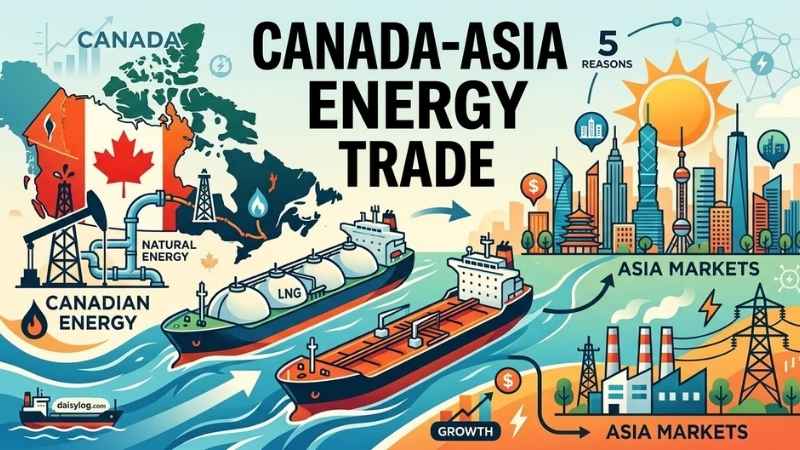
5 Reasons Canada Is Expanding Energy Trade With Asia
1. A Concentrated Customer Base Creates Trade Risk
Imagine running a small business whose largest customer provides most of its revenue. Even a good relationship leaves the business exposed if that customer changes its purchasing terms.
The Canada Energy Regulator’s 2026 analysis of energy security and trade diversification identifies tariff volatility and uncertain trade relationships as reasons for renewed interest in diversification. www.cer-rec.gc.ca
Having other customers gives exporters more options when one market faces policy changes or transportation problems.
The commercial logic is easy to understand: a reliable customer is valuable, and a wider customer base offers additional protection.
2. Canada Has More Access to Pacific Shipping Routes
Resources need a route to market. A warehouse full of goods is useful only if there is a workable way to deliver them.
The Trans Mountain expansion in 2024 widened access from western Canada’s oil-producing regions to the Pacific coast. Statistics Canada identifies the expansion as a major contributor to the changes in overseas oil shipments in 2025. www.statcan.gc.ca
This is an important distinction: Trans Mountain carries oil. LNG Canada exports liquefied natural gas. They support Pacific trade through different infrastructure.
The chronology also matters. These facilities take years to develop. Their role in today’s trade strategy grew from investments and construction decisions made well before the latest announcements.
3. More Export Routes Can Improve Commercial Options
Canadian crude can sell below international benchmarks because of quality differences and transportation costs. CER also explains that tight pipeline capacity can widen that discount. www.cer-rec.gc.ca
Additional routes give producers more ways to reach buyers. In practical terms, a business can compare offers more effectively when it has a viable delivery option for more than one market.
Market access can help address transportation bottlenecks. It does not eliminate every reason one type of crude sells for less than another.
4. LNG Makes Direct Overseas Gas Trade Possible
LNG stands for liquefied natural gas. Cooling natural gas into a liquid makes it possible to transport it by ship to overseas customers.
In its September 14, 2026 update on Asia-Pacific energy cooperation, Natural Resources Canada reported approximately 130 LNG cargoes, representing about 9.7 million tonnes, shipped to Asia between June 2025 and August 2026. www.canada.ca
The government presents these connections as opportunities to attract investment and diversify trade.
Readers should still separate actual shipments from planned capacity and long-term policy goals. Those measures answer different questions.
5. Export Projects Can Support Investment and Local Work
An export terminal involves more than ships. Construction, equipment, maintenance, transportation, and related services can connect a project to businesses beyond the facility itself.
That helps explain why energy announcements often discuss employment and regional economic activity alongside export volumes.
The practical question is which jobs, in which communities, for how long? A large investment figure does not tell a family whether a suitable vacancy exists nearby.
LNG Canada’s expansion announcement provides a useful example because it distinguishes construction work from additional operational roles.
Oil and LNG: The Difference Behind the Headlines
| Question | Crude oil exports | Natural gas and LNG exports |
|---|---|---|
| What is being sold? | Oil that refineries process into products | Natural gas, including gas liquefied for shipping |
| How does it commonly reach the U.S.? | Cross-border pipelines | Cross-border gas pipelines |
| What is a Pacific export example? | Oil reaching the coast through Trans Mountain, then travelling by ship | LNG loaded onto carriers at LNG Canada |
| What additional infrastructure is needed? | Oil transportation and loading capacity | Gas supply, liquefaction facilities, and LNG shipping |
| What should readers check? | Whether a statistic covers oil or all energy | Whether a figure represents actual exports or production capacity |
Whenever a headline says “Canadian energy is heading to Asia,” first ask which resource it means.
That small habit makes it easier to compare projects and understand the numbers.
When the Elephant Turns Away: How the Ant Survives
Former prime minister Pierre Trudeau described living beside the United States as being “like sleeping with an elephant.” The Brian Mulroney Institute of Government’s Canada–U.S. history resource identifies the remark with his March 1969 speech in Washington. www.mulroneyinstitute.ca
A large neighbour does not need to intend harm to make its movements felt. Its decisions can still change the ground beneath everyone nearby.
Canada’s current approach is rather like changing the sleeping arrangement. It keeps its relationship with the neighbour while creating other places to stand when conditions change.
For a household, the comparison might be a family broadening its sources of income. One dependable source can support the budget for years. Additional options can make an unexpected change easier to manage.
At the end of a new export route are people with ordinary responsibilities: a worker maintaining equipment, a contractor planning the next project, a parent deciding whether a move makes sense.
That is where a national trade strategy meets daily life.
LNG Canada Expansion: How Many B.C. Jobs Could It Create?
Construction employment and long-term operations employment need to be counted separately.
In its September 28, 2026 announcement of the Phase 2 final investment decision, LNG Canada described an expansion intended to increase annual production capacity from 14 million to 28 million tonnes.
That is a planned capacity increase. It does not mean current shipments have already doubled.
The company’s employment forecasts also cover different stages:
| Stage and location | Company’s forecast | How to interpret it |
|---|---|---|
| Kitimat expansion construction | Up to 4,000 new jobs at peak construction | Construction-stage work |
| Connecting pipeline compressor-station construction | Approximately 2,100 jobs | A separate scope of work |
| Additional Kitimat operations roles after completion | About 90 full-time roles and 150 contractor positions | Additional operational employment |
These figures come from the company’s expansion announcement. www.lngcanada.ca
They are company forecasts, not a count of vacancies currently accepting applications. The announcement comes from the project developer, so its employment expectations should be identified as such.
What Should Vancouver and Richmond Residents Check?
A job described as being “in British Columbia” may still be far from home. Kitimat is outside Metro Vancouver.
Before imagining how a project could fit into your life, check the actual posting:
- Location: Where will you physically work?
- Duration: Is the role tied to construction or ongoing operations?
- Requirements: What experience, credentials, and training does it ask for?
- Living arrangements: What would accommodation, travel, and shift schedules involve?
These are questions for reviewing a vacancy, not confirmed conditions for every project role.
Anyone preparing to move to Canada should also check their own work eligibility. A national investment announcement cannot establish an individual applicant’s employment or immigration outcome.
Questions Readers Often Ask About Canada’s Energy Trade
Will Canada Send All Its U.S.-Bound Energy to Asia?
The U.S. remains a major buyer, supported by existing transportation links.
The 2025 oil figures show how much that relationship still matters: destinations outside the U.S. received just over one-tenth of the measured export volume. Growing overseas sales and continued American importance can both be true. www.statcan.gc.ca
Will More Exports Make Canadian Gasoline Cheaper?
Export growth alone cannot establish what drivers will pay at the pump.
A producer’s crude oil selling price and a consumer’s gasoline purchase price are different measures.
Pump prices also involve refining, distribution, taxes, and local supply conditions. An improvement in export options should therefore not be treated as a promise of lower household fuel bills.
Could Canada Become Too Dependent on Another Country?
That is a useful question to keep asking.
A new route expands choice, but sales could still become concentrated among a small number of customers.
The longer-term issue is how widely Canada spreads its markets, alongside how much it ships through a particular port.
Does More Energy Investment Make Finding Work Easier?
It can create opportunities in particular places and occupations. It does not establish that every region or every applicant will benefit equally.
CER’s analysis also notes limits to diversification arising from infrastructure oriented toward the U.S. Changes in trade networks take time. www.cer-rec.gc.ca
For a job seeker, an announcement is a reason to investigate an industry. The vacancy itself is where you can check whether an opportunity matches your skills and circumstances.
Big Economic Headlines, Small Grocery Receipts
When I read about billions of dollars in investment, I find myself thinking about much smaller numbers: groceries, rent, and the next household bill.
For families living in Canada, the question can be very ordinary. Will there be work we can realistically apply for? Would taking that work mean moving away from our support network? How would a new schedule affect the children?
Someone waiting for immigration paperwork may read the same headline with a different kind of urgency. A growing industry sounds encouraging, but the distance between a national announcement and a personal opportunity can feel long.
It helps to make the next step smaller. Read one job posting carefully. Check its location. Compare its requirements with your experience. Separate information you can act on today from developments that still need time.
And if the news starts to feel heavy, it is fine to step away for a while. A cup of tea, a short walk, or finishing one ordinary task can give the day some steadiness.
Our lives still need attention while the larger economy changes around us.
Canadian Energy Exports: What Everyday Readers Should Remember
Canada is expanding its options for selling oil and gas overseas while maintaining a substantial relationship with American buyers.
Three habits make the story easier to follow:
- Read the scope of the statistic. Oil exports, LNG cargoes, and total energy trade are different measures.
- Separate completed activity from future plans. A shipment has happened; an expansion forecast describes what may follow.
- Check the details behind employment promises. Location, occupation, timing, and contract duration matter.
For people living in Canada or planning to settle here, understanding the direction of change is useful.
The next task is finding the part that connects to your own life, one practical question at a time.
Data note: Oil export figures refer to 2025 crude oil and equivalent products. LNG cargo figures cover June 2025 through August 2026. Expansion capacity and employment figures are developer forecasts published in September 2026.
Read next: