
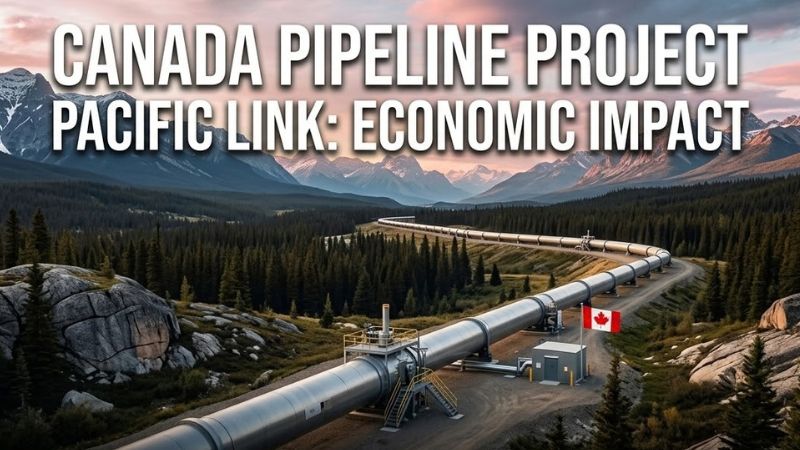
Pacific Link Pipeline sounds, at first, like the kind of Canadian news story many newcomers might scroll past.
Oil. Alberta. A pipeline. Ottawa. Another political argument.
But this one is worth stopping for.
Canada has officially placed a proposed new oil pipeline from Alberta to British Columbia on its list of projects of national interest, putting it into a new faster federal review system.
And whether you work anywhere near the energy industry or not, the project touches several issues that affect everyday life in Canada: jobs, government revenue, trade with Asia, public spending, Indigenous partnerships, the environment, and even the economic relationship between Alberta and British Columbia.
For immigrants building a life here, understanding stories like this also makes Canadian politics and the economy a little less mysterious.
So instead of getting lost in political sound bites, here is what is actually happening — and what has not happened yet.
What Is Canada’s New West Coast Oil Pipeline Project?
The project is a proposed crude oil pipeline running roughly 1,200 kilometres from the Bruderheim area in Alberta to southern British Columbia.
The federal government officially listed the project, now called Pacific Link, as a project of national interest on October 1, 2026.
The plan is to create enough additional pipeline capacity to move approximately one million barrels of oil per daytoward Canada’s West Coast, with growing Asian markets expected to be major customers.
That matters because Canada still sells a very large share of its crude oil to the United States.
For decades, that geography made sense. The U.S. is next door, it has enormous refining capacity, and pipelines already connect the two economies.
But dependence on one major customer can also become a weakness.
If Canada can sell more energy directly to buyers across the Pacific, the government believes the country could gain more flexibility when trade relationships become uncertain.
For anyone who has moved countries, there is an easy way to understand the idea.
You probably would not want your entire household income to depend on one client. Canada does not want most of one of its biggest exports depending on one customer either.
The federal announcement is available through the Prime Minister of Canada’s official Pacific Link announcement.
Wait — Has Canada Actually Approved the Pipeline?
This is where headlines can become confusing.
Yes and no.
The project has been formally listed under the Building Canada Act, meaning the federal government has already decided that it considers the project to be in Canada’s national interest.
But that does not mean crews can immediately start laying pipe across Alberta and B.C.
Important work still has to happen.
The route has to be developed in greater detail. Environmental studies must continue. Indigenous consultation must continue. Engineering, cost estimates, public hearings, safety planning, procurement and regulatory conditions still have to be completed.
Under the new system, the big federal question shifts from:
Should this project proceed?
toward:
Under what conditions should it proceed?
That is a significant difference.
Canada created the Building Canada Act to streamline federal approvals for selected infrastructure projects while still requiring regulatory review, environmental protections and consultation with Indigenous Peoples.
You can read how the process works on the Government of Canada’s Building Canada Act page.
Pacific Link Timeline: What Happens Next?
For readers trying to separate today’s announcement from tomorrow’s construction, this timeline is more useful than the political speeches.
| Stage | Expected Timing | What It Means |
|---|---|---|
| National-interest listing | October 1, 2026 | Federal government formally backs the project |
| Detailed planning and review | 2026–2027 | Route, engineering, environmental studies and consultations |
| Public and Indigenous hearings | Winter–Spring 2027 | Communities and affected groups participate in review |
| Federal conditions targeted | By September 1, 2027 | Conditions for construction could be finalized |
| Potential construction period | After approvals and conditions | Major hiring and procurement would occur here |
| Targeted operation | Around 2032–2033 | Pipeline could begin moving oil if schedules hold |
The words “if schedules hold” deserve emphasis.
Canadian infrastructure projects have a long history of changing timelines.
Legal challenges, environmental requirements, financing, construction costs, Indigenous consultation, provincial politics and market conditions can all change what happens next.
The federal government itself says the coming review will include technical, environmental, social, cultural, health, safety and security issues.
How Many Jobs Could the Pipeline Create in Canada?
This is probably where many newcomers will become more interested.
The federal government currently estimates that the development could support roughly 140,000 jobs across Canada and generate more than $20 billion in annual GDP.
Those are very large numbers.
But there is an important distinction between projected employment and 140,000 permanent pipeline jobs.
They are not the same thing.
Large infrastructure projects create economic activity in layers.
Direct construction and skilled-trade jobs
Possible occupations include:
- welders
- pipefitters
- heavy-equipment operators
- electricians
- engineers
- construction managers
- environmental specialists
- surveyors
- safety professionals
Indirect jobs
Projects of this scale also require:
- transportation
- equipment
- accommodation
- catering
- logistics
- manufacturing
- maintenance
- professional services
- accounting
- technology
- procurement
Local economic activity
Then there is another layer.
A construction worker earning a salary spends money on groceries, rent, restaurants, vehicles and services.
That spending creates activity outside the project itself.
So when governments publish very large employment numbers, they may include direct, indirect and induced employment over different stages of development.
That is why I would not read a headline saying “140,000 jobs” as meaning 140,000 new permanent positions will suddenly appear on Indeed.
The opportunity could be substantial, but it would develop over years, not overnight.
Could This Create Opportunities for Newcomers?
Possibly — especially if the project advances into full construction.
Western Canada already depends heavily on immigration to fill jobs across skilled trades, engineering, transportation, construction and professional services.
But there is also a practical reality newcomers discover quickly:
Having experience overseas does not always mean you can walk directly into the same Canadian occupation.
Some jobs require provincial certification.
Some regulated professions require Canadian licensing.
Some employers want Canadian safety credentials.
Trades may involve apprenticeship or Red Seal requirements.
That means a large project announcement is not a reason to quit your job tomorrow.
It is a reason to watch where future labour demand develops and prepare early.
Someone considering construction or infrastructure work might use the next few years to investigate credential recognition, apprenticeship programs, Canadian safety certificates or transferable skills.
That is a much more realistic way to interpret the employment side of this story.
Why Is Canada Trying to Sell More Oil to Asia?
Canada is a huge energy producer, but geography has always shaped its options.
The U.S. has traditionally been the easiest customer.
A West Coast export route potentially gives producers more direct access to economies across the Pacific.
Think about the difference between having one buyer and having several competing buyers.
With more potential customers, a seller may gain greater negotiating power and flexibility.
The federal government’s broader economic strategy is also focused on increasing Canadian exports outside the United States.
That goal has become more significant as countries around the world rethink supply chains, tariffs and economic security.
So this project is not simply an Alberta oil story.
It is also part of a bigger Canadian question:
How dependent should Canada be on the U.S. economy?
How Much Money Could Canada Make?
The numbers attached to the project are eye-catching.
Federal projections include more than $20 billion in additional GDP per year and approximately $100 billion in government revenue by 2060.
Why should an ordinary family care about government revenue from a pipeline?
Because government revenue eventually enters the same fiscal system that pays for things people use every day.
That can include:
health care, roads, public transit, schools, housing infrastructure and social programs.
That does not mean building one pipeline will magically lower your taxes or fix Canada’s housing shortage.
Public finances do not work that neatly.
But major export industries can influence tax revenue, corporate profits, wages, regional growth and government spending capacity.
For newcomers, this is one reason resource projects matter even if your own job is in technology, health care, retail or education.
Canada’s natural-resource economy and its public finances are more connected than they sometimes appear.
Who Is Paying for the Project?
This is also one of the more controversial parts of the story.
The federal government and Alberta are currently partners in advancing the project, and the federal announcement says Canada and Alberta will share equal ownership.
Indigenous communities are to be offered at least a 10% ownership interest, supported by government loan-guarantee programs.
Pembina Pipeline Corporation is participating as a private-sector investor, while Trans Mountain is leading project development expertise.
That structure leads to a reasonable taxpayer question:
How much public money could ultimately be at risk?
Supporters argue that public participation can move nationally important infrastructure forward when private companies are initially reluctant to carry development risk.
Critics argue that taxpayers should not absorb major financial risks that private investors are unwilling to take.
Both questions deserve attention.
For readers following the project over the next year, financing may be just as important as the route itself.
Indigenous Ownership Is a Bigger Part of This Project
One detail that should not be treated as a footnote is Indigenous participation.
The federal government says it consulted more than 130 Indigenous communities near or along potential routes before the national-interest listing.
The current plan includes offering Indigenous communities at least 10% ownership.
That could mean something quite different from the older model of simply building a project near Indigenous land and negotiating compensation afterward.
Equity ownership can potentially provide long-term revenue and greater economic participation.
But it does not mean every affected First Nation supports the project.
Questions remain around consultation, environmental effects, land rights, the size of the ownership share and how meaningful participation will be as the route is finalized.
Canada’s Major Projects Office says advancing Indigenous interests is one of the factors considered when evaluating national-interest projects. Its project-review framework can be found through the official Major Projects Office website.
Why Are Some People Strongly Against It?
If you live in British Columbia, you will probably hear a different conversation than you might hear in Alberta.
Environmental groups are concerned about greenhouse-gas emissions, possible spills, marine ecosystems and additional tanker traffic.
There are also concerns about sensitive species, including southern resident killer whales.
Some Indigenous representatives have questioned whether consultation and ownership arrangements go far enough.
Others worry about taxpayers taking financial risks.
Meanwhile, business groups and Alberta’s government argue that Canada has spent too long struggling to build major infrastructure and needs better access to international markets.
This is why pipeline debates in Canada can feel unusually emotional.
They are never only about a pipe.
They are arguments about climate change, jobs, federalism, Indigenous rights, regional identity, taxation and Canada’s economic future — all at the same time.
Alberta and British Columbia See This Differently
If you are new to Canada, understanding this regional tension will help you understand a lot of Canadian politics.
Alberta’s economy has deep ties to oil and gas.
For Alberta, getting energy to additional overseas markets is often framed as an economic necessity.
British Columbia, meanwhile, carries many of the coastal and environmental risks associated with transporting that product to the Pacific.
So one province can see a pipeline primarily as an export opportunity while another sees the same project partly through its environmental consequences.
Neither perspective disappears simply because Ottawa calls the development nationally important.
That tension will almost certainly remain part of the story as the project moves through consultation and review.
What Newcomers Should Watch in 2027
If you are following this story because of employment, business or simply because you want to understand Canada better, I would watch five things.
First, watch the final route. Communities located near construction activity could see very different economic impacts.
Second, watch hiring and procurement requirements. Local hiring rules and contracting plans could determine where opportunities actually appear.
Third, watch private investment. More private capital would change the project’s financial risk profile.
Fourth, watch Indigenous agreements. Ownership percentages, consultation and benefit agreements could become major parts of the final structure.
Finally, watch the September 2027 federal conditions. That will tell us much more about what Canada is actually preparing to build.
Until then, many of the biggest numbers being discussed remain forecasts.
The Bigger Story Is About the Kind of Economy Canada Wants
When I first see infrastructure announcements with numbers measured in tens of billions of dollars, they can feel strangely distant from normal life.
Most families are thinking about a mortgage payment, grocery prices, daycare or whether their salary is keeping up with rent.
A giant pipeline seems to belong to another world.
But zoom out and the connection becomes easier to see.
Canada has to decide how it earns money in a changing global economy.
Should it sell more natural resources abroad?
How much should governments invest to make that happen?
How quickly should large infrastructure projects be approved?
How should economic development be balanced with climate commitments and environmental protection?
And how should Indigenous communities participate in the wealth created from projects crossing traditional territories?
Those decisions eventually shape the job market, tax base and public services that all residents share.
That is why the Pacific Link Pipeline is worth following even if you never plan to work in oil and gas.
It is not simply a pipeline story.
It is a window into how Canada is trying to balance resources, trade, climate, public money and economic independence — and those choices will help shape the country newcomers are building their lives in.
Sources and Editorial Note
This article is based on information available as of October 7, 2026. Employment, GDP, government-revenue and completion figures are government projections rather than guaranteed outcomes. Project details may change during regulatory review, consultation, financing and final engineering.
Read next: