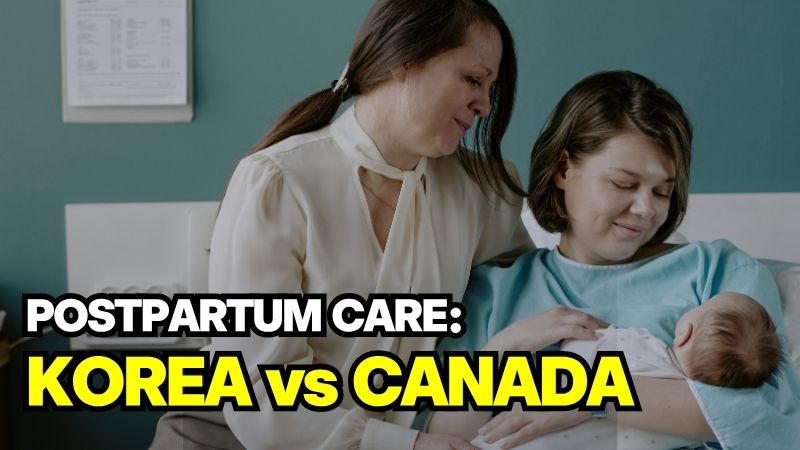
Korean postpartum care can look almost like another world when you compare it with having a baby in Canada.
In Korea, people often talk about rest, warm meals, postpartum care centers, and giving the mother protected time to recover. In Canada, the support is less visible in that “recovery-center” sense, but there is still a well-developed system around medical recovery, mental health, newborn care, and parental leave.
Having experienced childbirth in Canada as a Korean mom, I no longer see this as a simple question of which country does it better. The two systems often solve the same problem in very different ways.
What Postpartum Recovery Looks Like in Canada 🍁
In Canada, postpartum recovery is usually discussed as part of a broader health journey after childbirth.
There is attention to physical healing, bleeding, pain, sleep, feeding, emotional changes, mental health, newborn care, and knowing when something is not right. The Government of Canada’s official postpartum health guide also encourages new parents to ask partners, family, friends, and health professionals for help when the newborn period becomes overwhelming.
That is one thing I have come to appreciate about the Canadian approach.
The recovery may not always be wrapped in a clearly defined cultural concept like Korea’s sanhujori, but the mother’s physical and emotional health is still treated as part of postpartum care rather than something she should simply handle alone.
The exact services available after birth can also differ by province, health authority, hospital, and personal medical needs. That makes it important for expectant parents to ask about local postpartum support before the baby arrives.
How Postpartum Care Is Understood in Korea 🇰🇷
In Korea, postpartum recovery is not just a medical subject.
It is also cultural.
Many Korean women grow up hearing that after childbirth, a mother should rest properly, eat well, avoid overexertion, stay warm, and give her body enough time to recover.
That idea is often described as 산후조리 (sanhujori).
For many families, it may include:
- staying at a postpartum care center
- eating warm, nourishing meals such as seaweed soup
- receiving help with newborn care
- getting breastfeeding support
- limiting housework and physical strain
- using home postpartum helpers
- receiving family support
- slowly returning to normal exercise and daily routines
What makes Korea especially interesting is that maternal recovery is often very visible.
People expect the mother to need care.
There is less of a feeling that once the baby is born, all attention should suddenly move away from the mother.
Postpartum Care Centers in Korea: Not Just a Luxury Trend
The postpartum care center is probably the part of Korean childbirth culture that attracts the most attention from people overseas.
A mother usually stays in a private facility after leaving the hospital, while staff assist with newborn care, meals, feeding, and daily recovery.
Depending on the facility, mothers may have private rooms, scheduled meals, breastfeeding assistance, newborn monitoring, classes, massages, or other recovery-related services.
But these centers are generally private paid services, not a universal free government benefit.
And they are not something used by only a tiny group of wealthy mothers.
According to Korea’s Ministry of Health and Welfare 2024 Postpartum Care Survey, which surveyed 3,221 mothers who had given birth in 2023, 85.5% reported using a postpartum care center. Multiple responses were allowed because mothers could recover in more than one location.
The average stay at a center was 12.6 days, while the average amount spent at a postpartum care center was about 2.865 million KRW.
You can see the full figures in the Ministry of Health and Welfare’s official postpartum care survey results.
Those numbers help explain something important.
Postpartum centers are private, but structured postpartum recovery has become a very normal part of childbirth for many Korean families.
Korea Also Has Public Support Behind the Private System
It would be misleading to describe Korea’s system as nothing more than expensive postpartum centers.
There is a public-support layer too.
Korea’s Ministry of Health and Welfare lists several pregnancy, childbirth, and newborn programs, including the First Meeting Voucher and the Maternal and Newborn Health Management Support Program.
For children born from January 1, 2024, the First Meeting Voucher provides 2 million KRW for a first child and 3 million KRW for a second or later child, subject to the program rules.
The maternal-newborn program is especially relevant to postpartum recovery. Eligible households can receive support from trained health-management workers who visit the home and help with areas such as maternal recovery, newborn bathing and feeding, preparing the mother’s meals, and laundry related to the mother and baby.
Current national program details are available through Korea’s Ministry of Health and Welfare pregnancy and childbirth support page.
So although a private postpartum center itself is not automatically free, Korea’s larger maternity system includes several forms of public support around childbirth and early newborn care.
Local Government Benefits Can Make a Big Difference
Another part that can confuse people outside Korea is that postpartum benefits are not identical everywhere.
National programs are only one layer.
Cities and local governments may provide additional support.
Seoul is a good example.
As of 2026, Seoul’s postpartum care expense program lists 1 million KRW for a first child, 1.2 million KRW for a second child, and 1.5 million KRW for a third or later child for eligible Seoul residents.
The city also sets its own application and usage rules, so mothers need to check the current requirements rather than assuming that every Korean city offers the same benefit.
The updated amounts and eligibility information can be checked through the official Seoul postpartum care support page.
This layered structure is one reason Korean maternity support can seem complicated from the outside.
It is really a combination of national benefits + local benefits + private services + family and cultural practices.
Korea vs Canada: The Difference at a Glance
| Area | Korea 🇰🇷 | Canada 🍁 |
|---|---|---|
| Main visible focus | Structured maternal recovery | Health recovery and family adjustment |
| Typical recovery setting | Home and often postpartum care center | Mostly home after hospital discharge |
| Postpartum culture | Strong cultural emphasis on sanhujori | Less formal cultural recovery tradition |
| Newborn help | Family, private centers, home-care programs | Partner, family, healthcare and community support |
| Maternal meals/rest | Often highly emphasized | Encouraged, but usually managed at home |
| Private postpartum centers | Common | Uncommon |
| Government support | National and local childbirth programs | Provincial healthcare plus federal benefits |
| Parental leave | Available through Korean employment systems | Major part of family support for eligible parents |
| Overall feeling | Build a recovery environment around mom | Give the family time and health support to adjust |
This table describes broad tendencies rather than every mother’s experience.
Income, employment, family support, location, medical needs, immigration status, and personal choices can completely change what postpartum life looks like in either country.
One Canadian Strength I Did Not Fully Appreciate Until I Needed It
This was the part I understood only after having my own baby.
I was pregnant during COVID while I was still going through my Canadian visa process. I did not yet have permanent residency, and originally I had hoped that I might be able to return to Korea for childbirth.
Then the pandemic changed everything.
Travel became difficult, entry rules were complicated, and in the end I gave birth in Canada.
I had no parents or relatives nearby. There was no Korean-style postpartum care center waiting for me after I left the hospital.
That frightened me more than the delivery itself in some ways.
Still, one memory from that period has stayed with me: the hospital staff treated me kindly and cared for me like any other pregnant woman, even though I was still going through my immigration process.
That meant more to me than I probably realized at the time.
My Husband’s Parental Leave Changed My Recovery
After we came home, another Canadian system suddenly stopped feeling like a government policy and started feeling very personal.
My husband was able to take parental leave.
That meant I was not immediately left alone to recover while also learning how to care for a newborn.
He could hold the baby while I slept.
He could help when I was sore and exhausted.
He could learn the baby’s routine at the same time I did.
For eligible parents outside Quebec, Canada’s federal Employment Insurance maternity and parental benefits provide financial assistance while taking time away from work for pregnancy, birth, or caring for a newborn or newly adopted child.
In 2026, maternity and standard parental benefits can pay 55% of average insurable earnings, up to the annual maximum, while extended parental benefits use a lower weekly rate over a longer period. Current limits and eligibility should always be checked because the maximum amount can change.
The details are available on the Government of Canada’s official EI maternity and parental benefits page.
For our family, the biggest benefit was not simply the money.
It was time.
Time for me to recover.
Time for my husband to become confident with the baby.
And time for us to figure out our new life together without one exhausted person carrying everything.
The Part of Korea I Still Envied
Even with that support, I would be lying if I said I never envied mothers recovering in Korea.
I did.
When you are tired, sore, hormonal, sleep-deprived, and trying to understand a newborn, the idea of someone bringing you meals and helping with the baby sounds wonderful.
The Korean system does something psychologically important too: it makes the mother’s recovery visible.
A new mom is not simply expected to become the household manager again because the delivery is over.
There is a period when people recognize that her body has gone through something enormous.
That idea deserves more attention everywhere.
But Canada Has Its Own Well-Built System Too
As time passed, however, I became more balanced about the comparison.
Korea has developed an impressive culture and service system around caring for both the mother and baby, with particularly strong attention to helping the mother physically recover.
Canada does not have the same postpartum-center culture.
But that does not mean there is no system.
The support is simply organized differently.
Canada places more emphasis on healthcare guidance, mental health awareness, postpartum warning signs, breastfeeding and newborn information, medical follow-up, and giving eligible parents time away from work.
One system makes recovery very visible through places and services.
The other often makes support visible through time, healthcare, and shared parenting.
Three Things I Would Tell a Korean Mom Giving Birth in Canada 💡
1. Ask About Postpartum Support Before Delivery
Do not wait until you are standing in your kitchen with a three-day-old baby and no sleep.
Ask your hospital, doctor, midwife, or local health authority what postpartum services are available where you live.
Programs differ from province to province and even by health region.
2. Plan Who Will Take Care of the Mother
Everyone prepares diapers, bottles, clothing, and a crib.
But someone should also ask:
Who is making the mother’s food? Who is letting her sleep? Who is doing laundry? Who is watching the baby while she showers?
Those questions may sound small before childbirth.
After childbirth, they are not small at all.
3. Use Parental Leave as Recovery Support, Not Just Baby Care
If a partner can take leave, discuss responsibilities before the baby arrives.
Parental leave does not have to mean two exhausted adults sitting beside the same baby all day.
One person can handle a feeding or diaper change while the other sleeps. Someone can prepare food. Someone can take the baby for a walk.
That kind of practical teamwork became my Canadian version of sanhujori.
What I Would Take From Each Country
If I could design my own perfect postpartum system, I would borrow from both.
From Korea, I would take:
- protected recovery time for the mother
- nutritious meals
- practical newborn help
- the idea that maternal recovery deserves real attention
- easier access to hands-on postpartum support
From Canada, I would take:
- strong medical and mental-health guidance
- partner involvement from the beginning
- maternity and parental leave
- flexibility for different family structures
- the idea that caring for a newborn is not automatically only the mother’s job
I do not think mothers need to choose which philosophy is “correct.”
They can complement each other surprisingly well.
Final Thoughts 💛
Korean postpartum care feels so different from Canada because the support is often easier to see.
In Korea, recovery may have a place, a name, special meals, dedicated helpers, and a defined period of rest.
In Canada, much of the support may come through healthcare, parental leave, a partner taking on more responsibility, and guidance that follows the mother and baby after birth.
After experiencing childbirth in Canada myself, I cannot say one country simply gets everything right.
Korea made me appreciate how important it is to care for the mother.
Canada made me appreciate how important it is to give a family time to recover together.
If I could keep the best part of each, I would choose Korea’s strong maternal-recovery culture and Canada’s emphasis on shared parenting and leave.
Because after a baby is born, there are really two people who need care: the newborn who just arrived, and the mother who just went through childbirth.
Read next :