
This article provides general legal and tax information, not individual legal, medical or accounting advice. Program eligibility depends on personal circumstances and current government rules.
Is diabetes a disability in Canada? The shortest answer is yes—but not in every situation and not for every benefit.
A person can look perfectly healthy while quietly checking a glucose reading under the table. They may return to a meeting while calculating insulin, carbohydrates and the effect of a short walk they have not taken yet.
There is no wheelchair in the room. No cast. No visible sign asking other people to be patient.
But the work inside the body never clocks out.
That is why diabetes is often described as an invisible disability. Canadian law and benefit programs can recognize it that way, but they do not all ask the same question.
One system asks whether you need accommodation at work. Another looks at life-sustaining therapy. A third asks whether you can regularly perform substantially gainful work.
Understanding those three different tests can save you from applying for the right support with the wrong argument.
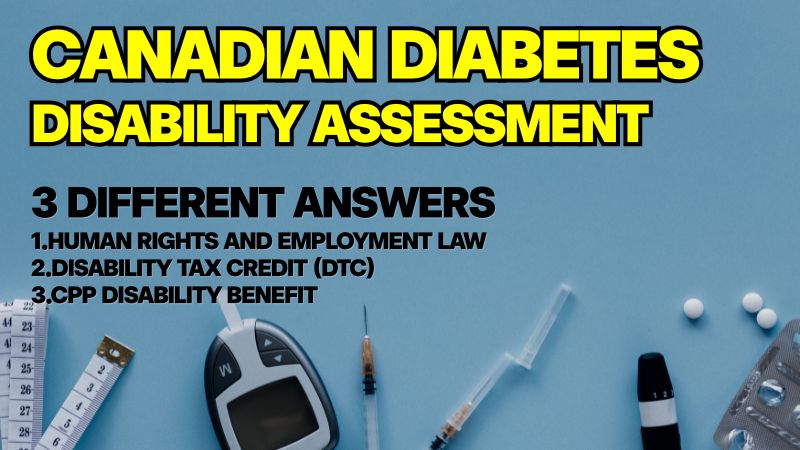
The Same Diagnosis Can Produce Three Different Answers
“Disability” is not one universal Canadian status.
It is a word used by several systems, each for a different purpose.
| Canadian system | The main question it asks | Possible result |
|---|---|---|
| Human rights and employment law | Does the condition create disability-related needs or barriers? | Workplace accommodation may be required |
| Disability Tax Credit | Do you meet a qualifying functional or life-sustaining therapy test? | A non-refundable tax credit may be available |
| CPP disability benefit | Does a severe and prolonged condition regularly prevent substantially gainful work? | Monthly income support may be available |
You might be protected at work but not qualify for CPP disability benefits.
You might qualify for the DTC while continuing to work full-time.
You might also have diabetes without meeting the eligibility rules for a particular financial program.
Being recognized under one system does not automatically approve you under another.
When Diabetes Is an Invisible Disability at Work
Canadian human rights protection does not begin only when a condition becomes visible.
If diabetes creates a disability-related need, an employee may be entitled to reasonable workplace accommodation. The exact law depends on whether the workplace is federally or provincially regulated, but the general principle is similar.
The Canadian Human Rights Commission explains that employers and service providers may have a duty to accommodate by adjusting rules, policies or practices so people can participate fully, up to the point of undue hardship.
For someone with diabetes, a reasonable accommodation might include:
- Brief breaks to check glucose or take medication
- Permission to keep food, water or diabetes supplies nearby
- A private and clean place to administer insulin
- Time to attend necessary medical appointments
- A predictable meal break
- Changes to a shift schedule when medically supported
- A safe place to store medication
This does not mean an employee can demand any arrangement they prefer. The employee and employer generally need to cooperate in finding a reasonable solution.
It also does not mean everyone at work needs to know the diagnosis. Medical information should be limited to what is reasonably needed to understand and accommodate the restriction.
The important point is this: a condition does not need to be visible before it creates a real barrier.
A Day Measured in Small Decisions
At 7:02 a.m., the first number appears.
Before breakfast, there are already questions. Is the glucose level rising or falling? How many carbohydrates are on the plate? Is today’s morning walk likely to change the dose?
Lunch brings another calculation. Exercise creates another decision. Illness, stress, interrupted sleep and an unfamiliar meal can change the plan again.
A widely cited Stanford Medicine article estimated that a person living with Type 1 diabetes may make around 180 additional health-related decisions each day.
The number should be understood as an estimate, not a stopwatch measurement that applies to every patient. Still, it captures something that a diagnosis code cannot show: the mental work is repetitive, invisible and difficult to pause.
Should I eat now?
Is it safe to exercise?
Did I calculate the dose correctly?
Do I have enough supplies to leave home?
Each decision may take only a moment. Together, they shape the entire day.
That hidden workload helps explain why Canadian systems sometimes recognize diabetes-related limitations even when the person appears outwardly well.
Does Diabetes Qualify for the Disability Tax Credit?
The Disability Tax Credit, commonly called the DTC, is a non-refundable tax credit. It is intended to reduce some of the income tax payable by an eligible person or, in certain situations, a supporting family member.
It is not a monthly disability pension. Approval also does not necessarily mean that the applicant cannot work.
People with diabetes commonly apply under the life-sustaining therapy category. This is where an important distinction between Type 1 and Type 2 diabetes appears.
Type 1 diabetes: the rule changed
For the 2021 and later tax years, people with Type 1 diabetes are considered to meet the life-sustaining therapy eligibility criteria.
A medical practitioner no longer needs to provide a detailed calculation showing that insulin therapy takes at least 14 hours each week.
However, this does not mean money appears automatically after diagnosis. An application still needs to be submitted and medically certified.
The current CRA life-sustaining therapy rules should always be checked before applying.
Type 2 diabetes: diagnosis alone is not enough
A person with Type 2 diabetes who uses insulin may also qualify under life-sustaining therapy.
However, the applicant generally needs medical certification and details showing that eligible therapy activities are required for an average of at least 14 hours per week.
This is where many online explanations become misleading.
The CRA is not simply asking:
“How much time do you spend thinking about diabetes?”
It asks how much time is spent on specific eligible activities connected to life-sustaining therapy.
What Can Count Toward the 14 Hours?
For applicants who must establish the time requirement, eligible activities may include:
- Adjusting and administering medication
- Determining an appropriate dosage
- Maintaining therapy-related records
- Setting up and maintaining therapy equipment
- Receiving qualifying therapy
- Certain dietary calculations required to determine medication dosage
- Eligible assistance or supervision provided to a child
Not every diabetes-related task counts.
Time spent exercising generally does not count. Neither does ordinary grocery shopping, travelling to an appointment, picking up medication or waiting while a portable device delivers therapy.
That distinction can feel unfair. A person may organize an entire day around diabetes while the CRA counts only certain minutes within it.
But understanding the distinction is essential when preparing an application.
The DTC Mistake That Leads to Weak Applications
Imagine a Type 2 insulin user named Daniel. This is a fictional example based on common application problems.
Daniel asks his doctor to write:
“Daniel has diabetes and needs insulin.”
The statement is medically correct. It may still be insufficient for the DTC.
Daniel assumed the diagnosis was the application. The CRA was looking for evidence connected to its eligibility test: frequency, duration, qualifying activities and the role of the therapy.
A stronger preparation process would include:
- Confirming which DTC category applies
- Reading the CRA definition of eligible activities
- Recording those activities separately from general diabetes management
- Discussing the actual therapy routine with the certifying practitioner
- Checking that both sections of the application are complete
For Type 1 diabetes and tax years from 2021 onward, a weekly time diary is not required to establish the 14-hour rule. For an insulin-using Type 2 applicant relying on life-sustaining therapy, accurate time information can still be central.
That difference is not a small technicality. It changes the whole application.
A Practical Therapy Log for Type 2 Applicants
A therapy log should be honest, ordinary and specific.
Avoid vague statements such as:
- “Diabetes takes all day.”
- “I am always monitoring my health.”
- “Managing food requires many hours.”
Instead, separate eligible tasks.
| Activity | Frequency | Minutes each time | Weekly total |
|---|---|---|---|
| Checking information needed to adjust insulin | |||
| Calculating and adjusting dosage | |||
| Administering insulin | |||
| Maintaining therapy records | |||
| Setting up or maintaining equipment |
Do not inflate the minutes. Consistent, explainable information is more useful than a dramatic total that does not match the medical record.
Bring the completed notes to the medical appointment. The practitioner must use professional judgment and certify the appropriate section of the form.
How to Apply for the DTC Without Creating Delays
The CRA allows digital and paper applications.
For a digital application, the applicant completes Part A and provides the generated reference number to the medical practitioner. The practitioner then completes Part B.
For a paper application, both parts of Form T2201 must be completed and submitted together.
The CRA’s official DTC application guide recommends using only one application method.
Before submitting, check for:
- A missing signature
- Incomplete personal information
- An unanswered medical section
- Part A and Part B being submitted in incompatible formats
- An outdated paper form
- Missing information about the relevant years
- A request based only on diagnosis when additional criteria apply
It may also be helpful to keep a complete copy of everything submitted.
What If the DTC Application Is Denied?
A denial does not always mean that the person’s condition is unimportant.
It means the CRA decided that the information submitted did not establish the program’s legal criteria.
Read the notice carefully. Determine whether the problem concerns:
- Missing information
- The medical certification
- The qualifying category
- Therapy frequency
- The 14-hour calculation
- Activities that the CRA does not count
- The years for which eligibility was requested
Do not simply send the same explanation again.
Compare the decision with the current eligibility rules. If important medical or functional information was missing, speak with the certifying practitioner about whether clarification is appropriate.
For a complicated case, consider advice from a qualified tax professional or disability organization rather than a company promising guaranteed approval in exchange for a large percentage of the refund.
No private company can guarantee a CRA decision.
DTC Approval Is Not the Same as CPP Disability
This is one of the most important distinctions in the article.
The DTC can be available to someone who works, studies or manages many daily activities. CPP disability benefits use a much stricter work-capacity test.
CPP disability generally requires a condition that is both severe and prolonged and regularly prevents the person from doing substantially gainful work. Applicants must also satisfy CPP contribution requirements.
A diabetes diagnosis alone does not establish that level of occupational disability.
Severe complications or the combined effect of multiple conditions may be relevant, but Service Canada evaluates the individual evidence. Current requirements should be checked on the official CPP disability benefit page.
In simple terms:
- Workplace accommodation: Can a barrier be reasonably removed?
- DTC: Does the person meet a qualifying functional or therapy test?
- CPP disability: Does the condition regularly prevent substantially gainful employment?
Three programs. Three questions. Three potentially different answers.
Does Prediabetes Count as a Disability?
Prediabetes alone does not automatically create disability status or DTC eligibility.
The same is generally true of gestational diabetes. A temporary diagnosis does not automatically qualify someone for a disability tax credit or income benefit.
However, a person may still have workplace needs related to monitoring, appointments, medication or pregnancy. Those needs should be considered within the relevant employment and human rights framework.
This distinction matters to me because diabetes does not always begin with a dramatic diagnosis.
For many families, it first appears during pregnancy. It may continue after childbirth, improve for a time or remain as prediabetes. Family history can make the possibility of progression feel close even when medication is no longer needed.
That experience creates a genuine connection to the subject. But personal concern and legal eligibility are not the same thing. Each program must still apply its own test.
When an Invisible Condition Deserves a Visible Response
A wheelchair is not the entrance ticket to disability protection.
A glucose sensor under a sleeve may be invisible. So may the calculations, interrupted sleep, medical appointments and fear of getting a number wrong.
Canadian systems can recognize diabetes as a disability, but recognition depends on context. Workplace protection focuses on barriers and accommodation. The DTC focuses on defined functional or therapy criteria. CPP disability focuses on the capacity to work.
So, is diabetes a disability in Canada? Sometimes yes—and often in more than one way.
The most useful next step is not to ask only, “Do I have diabetes?”
Ask instead:
Which Canadian system am I applying to, and what exact question does that system require me to answer?
That is where a vague diagnosis becomes a clear path toward the right support.
READ NEXT: