
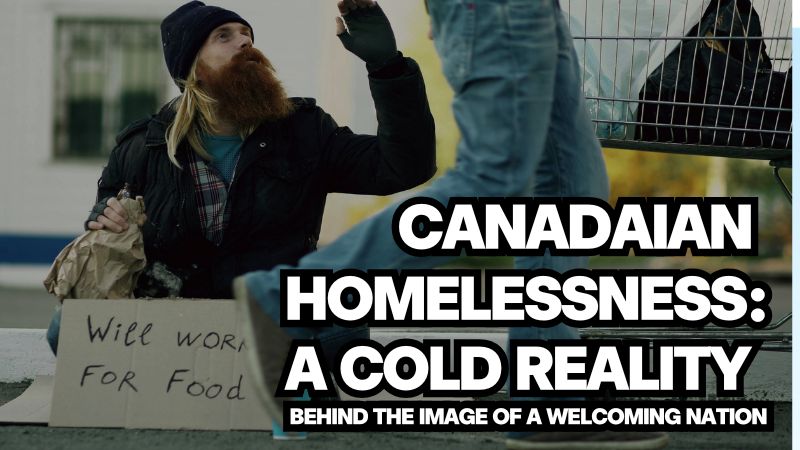
Homelessness in Canada can be one of the most unexpected sights for someone visiting the country for the first time.
Canada is often associated with beautiful nature, clean cities, political stability, and a relatively generous social safety net. Yet just beyond the glass towers of Vancouver, Toronto, and other major cities, another Canada exists.
People sleep on sidewalks.
Tents appear under bridges and beside public parks.
Shopping carts filled with personal belongings move slowly through some of the busiest neighbourhoods in the country.
I still remember how surprised I felt when I first came to Canada in my twenties.
I had imagined that homelessness would be more visible in isolated or neglected areas. Instead, I saw people sleeping close to crowded shopping districts, busy streets, restaurants, and expensive downtown buildings.
Even today, when I visit downtown Vancouver, I occasionally see people living in doorways, alleys, shelters, and temporary tents.
At some point, I began to wonder:
How do people survive Canada’s long, freezing winters without a home?
Do they receive welfare or government assistance?
Where do they eat, sleep, shower, and keep their belongings?
Canada has social programs, emergency shelters, food banks, and public housing. However, the existence of a support system does not mean that everyone can easily enter it.
For someone living without an address, identification, a phone, transportation, or a safe place to store documents, even applying for help can become a full-time struggle.
Is Homelessness Really Common in Canada?
It is difficult to calculate the exact number of people experiencing homelessness in Canada.
People staying in emergency shelters can be counted more easily. However, many others sleep in vehicles, stay temporarily with friends, move between motels, or live in hidden outdoor locations.
This is often called hidden homelessness.
According to Statistics Canada, approximately 11.2% of Canadians reported experiencing some form of homelessness during their lifetime in the 2021 Canadian Housing Survey. This does not mean that all of them slept on the street. The figure also includes people who temporarily had no stable or permanent place to live.
Read the Statistics Canada overview of homelessness
A national Point-in-Time Count conducted across dozens of Canadian communities in 2025 identified approximately 65,000 people staying in shelters, transitional housing, outdoor locations, or encampments on a single night.
Because this type of survey counts people visible or reachable on a specific day, the actual number may be higher.
View Canada’s 2025 homelessness count
The numbers also reveal something important.
Homelessness is not only about people sleeping on sidewalks. It includes people who have no reliable place to return to tomorrow.
Why Does Canada Have So Many Homeless People?
There is no single cause.
A person may lose housing after losing a job, experiencing family violence, developing a serious illness, leaving foster care, facing a rent increase, or being evicted.
In many cases, several problems happen at the same time.
1. High Rent and a Shortage of Affordable Housing
The most obvious cause is Canada’s housing affordability crisis.
Housing is generally considered affordable when a household spends less than 30% of its before-tax income on housing costs.
For many lower-income Canadians, finding a rental home within that limit is nearly impossible.
See the CMHC definition of affordable housing
In cities such as Vancouver and Toronto, even a small room can take up a large percentage of a person’s monthly income. Housing pressure has also spread to cities such as Ottawa, Halifax, Montreal, Calgary, and Victoria.
A person may be able to pay rent while working full-time. But one illness, job loss, family emergency, or unexpected bill can quickly destroy that balance.
Without savings, missing one or two rent payments may lead to eviction.
Research from the Canada Mortgage and Housing Corporation has also found a strong connection between eviction and homelessness. People who have recently been evicted are significantly more likely to experience hidden or visible homelessness.
Read the CMHC report on eviction and homelessness
For many people, homelessness does not begin with a dramatic decision. It begins with a rent payment they can no longer make.
2. Social Programs Exist, but Gaps Remain
Canada has income assistance, disability benefits, rental support programs, emergency shelters, public housing, and homelessness prevention services.
The federal Reaching Home program funds community organizations working to prevent and reduce homelessness.
Learn about Canada’s Reaching Home program
Provincial organizations, including BC Housing, also operate shelters, outreach services, supportive housing, and rental assistance programs.
However, having a program does not mean that a person receives help immediately.
Each program has its own rules.
Applicants may need to provide identification, income records, medical documents, proof of residency, tax information, or contact details.
Waiting lists can be long.
Public housing may not be available in the neighbourhood where a person lives or receives medical care.
Some applicants may qualify for assistance but remain unable to complete the application process.
Canada’s homelessness crisis is therefore not simply a story about a country with no social programs.
It is often a story about the gap between the speed at which someone loses a home and the speed at which support finally arrives.
3. Mental Health, Addiction, and Housing Are Connected
Not every homeless person has a mental illness or substance use disorder.
It is harmful and inaccurate to assume that everyone living outside is addicted to drugs or unwilling to work.
People may become homeless because of unaffordable rent, unemployment, domestic violence, disability, family breakdown, discrimination, or sudden medical costs.
However, mental health problems and addiction can make it much harder to leave homelessness once it begins.
Living outside creates constant stress.
A person may not sleep safely.
Medication may be lost or stolen.
Medical appointments may be missed.
Mental health symptoms may worsen under fear, cold, isolation, and exhaustion.
Canadian government research has found that a large percentage of people who experience homelessness also report mental health or substance use challenges.
Read Canada’s report on homelessness, mental health, and substance use
This does not mean addiction always causes homelessness.
Sometimes homelessness comes first.
The stress and danger of street life can then deepen an existing mental health condition or lead a person toward substance use as a way of coping.
An emergency shelter bed alone may not be enough.
Stable housing, medical care, income support, identification recovery, counselling, and long-term case management often need to work together.
Do All Homeless People Receive Government Benefits?
No.
A person does not automatically receive money simply because they are homeless.
Eligibility depends on factors such as income, age, disability, family situation, immigration status, and the province or territory where the person lives.
At the same time, being without a permanent address does not automatically disqualify someone from every benefit.
The real difficulty is often not eligibility.
It is access.
The Address Dilemma
Government agencies may need an address to send letters, replacement documents, benefit notices, or tax information.
A person sleeping outside may have no secure mailbox.
Some shelters and community agencies allow clients to receive mail at their address. However, not everyone is connected to those services.
A person may also move frequently between shelters, hospitals, temporary housing, and outdoor locations.
Important letters may never reach them.
A missed letter can lead to a missed appointment.
A missed appointment can delay or cancel an application.
This creates a frustrating situation:
A person may need benefits because they have no home, yet having no home makes the benefit process harder to complete.
Losing Identification Creates Another Trap
Living on the street increases the risk of losing personal documents.
Wallets, bags, and identification cards can be stolen, damaged by rain, or lost during shelter transfers or encampment removals.
Without identification, a person may struggle to:
- Open a bank account
- Apply for employment
- Sign a rental agreement
- Replace other documents
- Access certain medical or government services
- Complete benefit applications
Replacing one document may require another document.
It may also require a mailing address, payment, a witness, or proof of identity that the person no longer has.
People can lose documents because they are homeless, then remain homeless because they no longer have the documents needed to rebuild their lives.
Missing Tax Returns Can Mean Missing Benefits
In Canada, many federal and provincial benefits are connected to annual tax returns.
A person with little or no income may still need to file a tax return to receive certain credits and payments.
The Canada Revenue Agency explains that people facing housing insecurity may miss benefits if they do not file their taxes or cannot keep their personal information updated.
Free tax clinics are available through community organizations, but people must still know about the service and be able to attend.
This is why the question, “Why do they live outside if the government gives them money?” is too simple.
Qualifying for help and successfully receiving help are two different things.
How Do Homeless People Find Food in Canada?
People experiencing homelessness do not all survive by begging or searching through garbage.
Most Canadian cities have a network of food banks, churches, community centres, charities, drop-in programs, and free meal services.
Some organizations provide grocery hampers.
Others serve hot meals at specific times of the day.
In Vancouver, The Salvation Army’s Harbour Light program provides community meals and other support services.
Visit The Salvation Army Vancouver Harbour Light
The City of Vancouver also publishes information about free and low-cost food programs, including meal locations and food resources.
View Vancouver’s free and low-cost food resources
Still, food assistance is not always simple to use.
Meals are served at specific locations and times.
A person may have to walk or take public transit across the city.
Someone who arrives late may find that the food is gone.
Food banks may provide ingredients that require a refrigerator, stove, can opener, or storage space.
A person living in a tent may receive pasta, canned food, or frozen items but have no safe way to cook or store them.
Some people collect refundable bottles and cans.
Some ask strangers for money.
Others search discarded food or household items.
However, these activities should not be treated as the normal or universal lifestyle of every homeless person.
Each person survives differently.
Where Do Homeless People Sleep?
For many people living without housing, finding a place to sleep becomes a nightly survival game.
Emergency shelters offer temporary indoor space for people who are homeless or at immediate risk of losing housing.
Learn about BC Housing’s Emergency Shelter Program
However, a shelter bed is not guaranteed.
People may need to call before arriving.
Some shelters operate on a first-come, first-served basis.
Others use intake systems, referrals, waitlists, or specific eligibility requirements.
BC Housing recommends contacting shelters in advance to check bed availability and intake times.
Search for emergency shelters in British Columbia
BC211 also publishes shelter availability information for parts of British Columbia.
National data shows that Canada has hundreds of emergency shelters and tens of thousands of beds. Yet occupancy rates remain high, particularly in large urban areas.
View Canada’s shelter capacity data
A shelter bed may protect someone from the cold for one night.
It does not necessarily provide a place to return to the next day.
Many overnight shelters require people to leave in the morning.
They must carry their belongings, spend the day outside, and begin searching for another place to sleep again that evening.
Why Would Someone Choose a Tent Over a Shelter?
A tent is rarely comfortable or truly safe.
Still, some people avoid shelters because the shelter environment does not meet their needs.
Shelter rules vary.
Some facilities cannot accept pets.
Others may limit bicycles, shopping carts, large bags, or personal belongings.
Couples may be separated.
People may not be able to stay with a partner, family member, or trusted friend.
View Vancouver shelter locations and service details
Some people are afraid of theft.
Others feel unsafe sleeping in a crowded room with strangers.
A person with trauma, severe anxiety, or paranoia may find a shared indoor environment unbearable.
There may also be strict entry times, curfews, sobriety expectations, or rules about when people must leave.
None of this means that a tent is a good housing option.
It means that, for some people, a tent offers a small amount of control over their belongings, relationships, and surroundings.
An encampment is not necessarily a rejection of help. It may be the last available space between an unaffordable apartment and a shelter that cannot safely accommodate someone’s needs.
How Do Homeless People Survive a Canadian Winter?
Canada’s winter can be dangerous for anyone sleeping outside.
Cold temperatures, snow, rain, wind, wet clothing, and limited access to bathrooms create serious health risks.
During severe weather, cities and provinces may open temporary winter shelters, warming centres, and Extreme Weather Response shelters.
The City of Vancouver opens additional spaces when weather conditions become dangerous.
Read about Vancouver shelters and winter response services
These locations may provide mats, blankets, hot drinks, light meals, and temporary protection from the weather.
However, many winter shelters are only open overnight or during specific weather alerts.
When the morning comes, people may have to leave again.
Their tent, sleeping bag, clothing, and belongings may still be wet.
They may spend the day inside libraries, transit stations, shopping centres, hospitals, or community centres just to stay warm.
A warm room for one night can prevent a tragedy. It cannot replace a permanent home.
Is Homelessness a Personal Choice?
It is tempting to look at someone living outside and think, “Why do they not just get a job?”
But finding and keeping a job requires more than motivation.
A job applicant may need:
- Identification
- A phone number
- Clean clothing
- Transportation
- Regular sleep
- A bank account
- Internet access
- A stable schedule
- A safe place to store personal belongings
A person who spends each night searching for a shelter bed may arrive at work exhausted.
A stolen phone can mean missing a shift.
A wet sleeping bag can mean spending the morning trying to find warmth instead of attending an interview.
Personal decisions can influence anyone’s life.
However, reducing homelessness to laziness or poor choices ignores high rent, eviction, disability, family violence, illness, trauma, and gaps in public services.
Some people lose housing after years of stable employment.
Others leave unsafe homes.
Some age out of foster care without family support.
Some become ill and can no longer work.
Homelessness is not a personality type. It is a housing condition that a person is experiencing.
What Is the Canadian Government Doing?
Canada’s federal government funds homelessness prevention and housing programs through initiatives such as Reaching Home.
Provincial agencies provide emergency shelters, outreach teams, rent supplements, supportive housing, and eviction prevention programs.
BC Housing, for example, operates and funds multiple homelessness services throughout British Columbia.
Governments are not doing nothing.
Shelters are operating.
Outreach workers help people replace identification.
Community organizations provide food, clothing, tax clinics, medical care, and housing support.
However, expanding shelter space alone cannot solve the entire problem.
If rents continue rising faster than income, more people may lose housing even while new shelter beds are added.
This can turn the system into an emergency response network rather than a true exit from homelessness.
Long-term progress requires several services to work together:
- Affordable housing
- Eviction prevention
- Mental health treatment
- Addiction treatment
- Income assistance
- Disability support
- Identification recovery
- Tax filing help
- Employment services
- Long-term supportive housing
The goal should not only be helping people survive after they lose housing. It should also be preventing them from losing it in the first place.
Final Thoughts: What Are They Really Asking For?
Behind Canada’s glass towers and expensive downtown apartments, some people sleep on cold pavement.
What they need may be more than a bowl of hot soup.
A meal can ease hunger for a few hours.
A shelter mat can offer protection for one night.
A warm coat can help someone survive a freezing morning.
But people also need to be seen.
Not as part of the city’s scenery.
Not as a problem that should disappear before tourists arrive.
Not as a stereotype.
They need to be recognized as people who still have names, memories, fears, skills, families, and reasons for wanting another chance.
Perhaps what they long for is not only warmth from food or shelter, but the warmth of being treated as someone who still belongs in the human community.
A person may receive dinner tonight.
They may find a shelter bed before midnight.
But if there is no door they can return to tomorrow, the survival game begins again in the morning.
The tents hidden beneath Canada’s maple leaf do more than expose the contradictions of a wealthy country.
They remind us that rescuing someone after they lose everything is much harder than helping them keep their home before everything falls apart.
READ NEXT: