
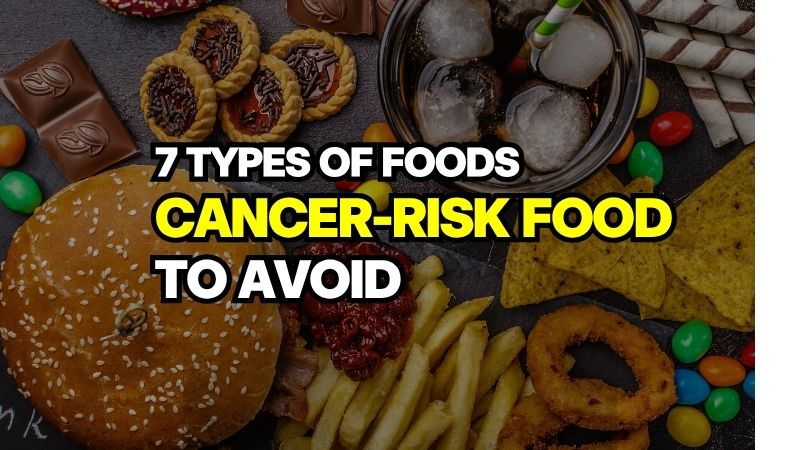
Cancer-risk foods are easy to ignore because they look so normal.
They are the foods many of us grew up with, grab on busy days, or eat without thinking twice.
But major health organizations keep repeating the same message: cancer risk is usually not about one dramatic meal. It is more often about a long pattern of eating certain foods too often over time. WHO, the National Cancer Institute, the Canadian Cancer Society, the American Cancer Society, and the World Cancer Research Fund all point back to that same big idea.
As I get older, this topic feels much more personal than it used to.
My mom had severe diabetes, and my dad has been taking blood pressure medicine for years. Because of that family history, I have become much more careful about what I eat.
After moving to Canada, there were many days when grabbing a quick fast-food meal felt like the easiest way to survive a busy schedule. That is one reason I care so much about foods linked to cancer risk.
In modern life, eating perfectly every day is not realistic. But I truly believe that avoiding the worst foods more often can help protect our bodies over time.
Even when I feel tired or busy, I try not to let grains and vegetables disappear from my meals. It may seem like a small habit, but I believe it makes a real difference.
📌 First, the important part: one time is not the same as “all the time”
Before we start, this is the key point: eating one hot dog at a baseball game is not the same as building your entire week around processed meat, soda, alcohol, and fast food.
The real danger is repetition.
WHO explains that processed meat is classified as carcinogenic to humans, with the strongest evidence for colorectal cancer. Its summary also says that eating 50 grams of processed meat a day is associated with about an 18% higher risk of colorectal cancer, and eating 100 grams of red meat a day is associated with about a 17% higher risk. You can read that on the official WHO Q&A on red and processed meat.
Quick comparison table 📊
| Food or pattern | Why people miss the risk | Why it matters |
|---|---|---|
| Processed meat | It feels ordinary | Strong evidence links regular intake to higher colorectal cancer risk |
| Too much red meat | It feels like a normal dinner default | Higher long-term intake is linked to higher cancer risk |
| Alcohol | People still think “a little is harmless” | Less is better for cancer risk |
| Charred meat | It feels like a cooking style, not a risk | High heat can create harmful chemicals |
| Ultra-processed foods | They are convenient and everywhere | They can crowd out fiber-rich, plant-rich foods |
| Sugary drinks | They seem small and easy to overlook | They can support unhealthy long-term eating patterns |
| Salt-preserved foods | They often feel traditional, not risky | Higher intake is linked to higher stomach cancer risk |
1) 🥓 Processed meat: bacon, ham, sausage, hot dogs, deli meat
Among all cancer-risk foods, processed meat gets the clearest warning.
WHO’s cancer agency classifies processed meat as carcinogenic to humans, with the strongest evidence pointing to colorectal cancer. The concern comes from the way meat is cured, smoked, salted, or preserved, which can create harmful compounds over time.
The surprising part is how little can count as “regular.”
About 50 grams a day is enough to show up in the research. That can be one hot dog, a few slices of bacon, or some deli meat in a sandwich. That is exactly why so many people miss how serious it can be. It does not feel excessive. It feels ordinary.
If you eat it once in a while, that is different from eating it every day.
When you do have it, it is smarter to pair it with vegetables, fruit, beans, or whole grains instead of turning one processed food into a fully processed meal with fries and soda. That advice fits broader cancer-prevention eating patterns that emphasize more plant foods and less processed food overall.
2) 🍖 Too much red meat
Red meat is not in the same category as processed meat, but it still appears on expert lists when eaten too often.
WHO classifies red meat as probably carcinogenic to humans, again with the main concern centered on colorectal cancer. Some evidence also points to possible links with pancreatic and prostate cancer. The same official WHO Q&A on red and processed meat explains this clearly.
One reason red meat may be a problem is that compounds formed from meat itself, along with the way it is cooked, may increase concern. And if red meat is also cooked at very high temperatures, the risk discussion becomes even more important.
That does not mean “never eat steak again.”
It means steak should not quietly become your default protein.
Better swaps are fish, beans, lentils, tofu, eggs, and poultry. Those choices fit the plant-rich, variety-focused eating patterns cancer organizations recommend.
3) 🍷 Alcohol, even when people think “it’s only a little”
This is one of the most underestimated items on the list.
Many people still think alcohol is mainly a liver issue, but cancer organizations are much more direct now. The Canadian Cancer Society says that drinking any type or amount of alcohol increases cancer risk, and that the less alcohol you drink, the lower your risk. Their official Canadian Cancer Society page on alcohol and cancer risk explains this in very plain language.
The lesson is simple: less is better.
There is no health halo that cancels out the cancer risk.
4) 🔥 Charred meat, open-flame barbecue, and very high-heat cooking
This is where cooking method matters just as much as the food itself.
The National Cancer Institute explains that cooking meat at very high temperatures, especially pan-frying or grilling directly over an open flame, can create chemicals called HCAs and PAHs. In laboratory studies, these chemicals have been shown to damage DNA and cause cancer in animal models. You can read that in the official National Cancer Institute fact sheet on high-temperature cooked meat.
That means grilled meat is not automatically evil.
But blackened, heavily charred meat all the time is not something to ignore either.
A few practical tricks can help:
- marinate meat before cooking
- avoid direct flame as much as possible
- cut off blackened parts
- choose roasting, braising, or stewing more often than heavy charring
Those are the kinds of small changes that can lower exposure without making life miserable.
5) 🍟 Ultra-processed foods and fast-food-based eating patterns
This is probably the most modern category because it feels so normal now.
Ultra-processed foods are often convenient, cheap, salty, sweet, and easy to repeat every day. That is exactly why they matter.
The American Cancer Society emphasizes a healthy eating pattern built around vegetables, fruits, whole grains, and healthier protein choices, while limiting foods high in added sugar, saturated fat, and salt. Its official American Cancer Society healthy eating guidance fits this bigger picture very well.
This part feels very real to me because life in Canada can get incredibly busy.
There were many days when fast food felt like the simplest answer. That is exactly why I now try not to skip grains and vegetables, even on rushed days. I may not eat perfectly, but I try hard not to let convenience food become my normal.
If fast food is unavoidable, try not to stack multiple risk factors in one meal.
A quick burger is one thing.
A burger with processed meat, fries, soda, and no fiber is a totally different pattern. That kind of stacking moves you further away from the eating pattern cancer organizations recommend.
6) 🥤 Sugary drinks
Sugary drinks deserve a place on this list because they are sneaky.
They do not look as scary as processed meat or alcohol, which is why people often overlook them.
The bigger issue is not that one drink suddenly causes cancer. It is that sugary drinks often become part of an overall eating pattern that supports excess calories, weight gain, and fewer nutrient-dense foods over time. The American Cancer Society’s guidance and the World Cancer Research Fund’s recommendations both push people toward healthier patterns with fewer sugary drinks and less heavily processed food.
One soda feels small.
Two a day feels normal.
But normal and harmless are not always the same thing.
Water, sparkling water, and unsweetened tea are much better defaults.
7) 🧂 Salt-preserved foods and mold-contaminated foods
This last category is less trendy but still important.
The World Cancer Research Fund says there is strong evidence that consuming foods preserved by salting increases the risk of stomach cancer. The research mainly relates to high-salt foods and salt-preserved foods, including pickled vegetables and salted or dried fish as traditionally prepared in East Asia. You can see that in the official World Cancer Research Fund stomach cancer report.
There is also the issue of aflatoxins, which are toxins made by certain molds.
The National Cancer Institute says aflatoxins can contaminate crops such as corn, peanuts, and tree nuts, and exposure is associated with a higher risk of liver cancer. So if nuts or grains smell odd, look moldy, or seem damaged, throwing them out is the safer choice.
🥗 What should you eat more often instead?
The good news is that major organizations do not just warn us about these foods.
They also give a pretty consistent picture of what a lower-risk eating pattern looks like: more vegetables, fruit, beans, and whole grains, and less processed food, processed meat, and alcohol. The American Cancer Society’s recommendations especially emphasize a plant-rich eating pattern and healthier everyday defaults.
That is why, even on busy days, I try to keep grains and vegetables on the table.
I honestly believe that in a hectic modern life, simply reducing the worst foods more often is already a big win.
Final thoughts ✨
The most dangerous thing about cancer-risk foods is not that they are shocking.
It is that they are familiar.
They are cheap, fast, social, and everywhere. That is why so many people keep eating them without realizing how strongly major organizations have warned about regular overuse. WHO has warned about processed meat. The Canadian Cancer Society has warned about alcohol. The National Cancer Institute has explained the concerns around high-heat meat cooking and aflatoxins. The World Cancer Research Fund has warned about salt-preserved foods. And cancer-prevention guidelines keep circling back to the same message: build your meals around real food more often.
No one eats perfectly every day.
But if we stop letting the worst foods become our everyday normal, that alone is a powerful step toward protecting the body for the long run.
Read next :