
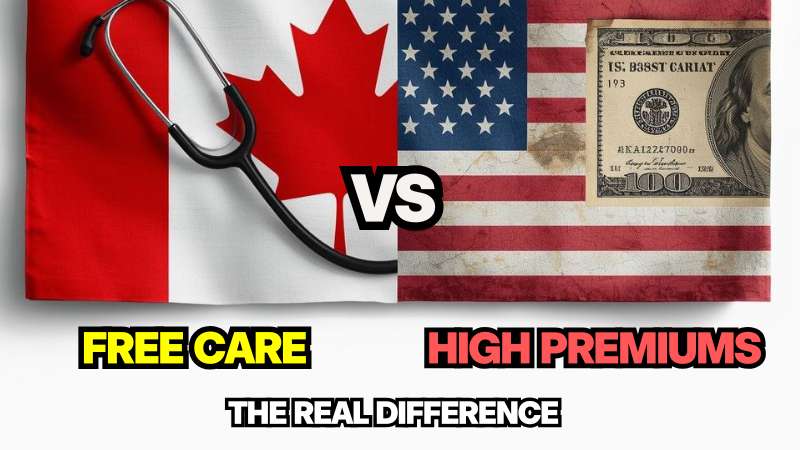
If you are raising kids in North America, Canada vs US healthcare is not just a policy topic. It is a daily life question. When a child gets a fever at night, when a parent needs a specialist, or when a family is planning a move, the system behind that care matters a lot. From a parent’s point of view, Canada and the United States may look similar on the map, but they feel very different once medical bills, waiting, and insurance rules become real.
Why this comparison feels confusing
Canada has a tax-funded public system. Provinces and territories run their own health plans, and eligible residents apply for public insurance where they live. Under the Canada Health Act, public plans must cover insured medically necessary hospital and physician services, which is laid out in the federal page on how publicly funded coverage works in Canada.
The United States does not have one single national family insurance plan. Many families get coverage through an employer, the Marketplace, Medicaid, or CHIP. Marketplace plans must cover essential health benefits, but families still need to think about premiums, deductibles, copays, coinsurance, and out-of-pocket costs. That basic structure is explained on HealthCare.gov’s Marketplace coverage page and its cost pages.
Quick comparison table
| Feature | Canada public healthcare | U.S. family insurance |
|---|---|---|
| Main structure | Public coverage run by provinces and territories | Employer plans, Marketplace plans, Medicaid, or CHIP |
| Core coverage | Medically necessary hospital and physician services | Essential health benefits in Marketplace plans, plus plan-specific cost sharing |
| What families often worry about | Wait times and access | Premiums, deductibles, networks, and bills |
| Childbirth and newborn care | Usually within medically necessary hospital/physician care for eligible residents | Covered in Marketplace and Medicaid plans, but cost sharing can still apply |
| Newcomers and visitors | Depends on provincial eligibility rules | Depends on income, immigration status, state rules, and plan type |
This table simplifies a complex topic, but it matches the official structure described by Canada.ca, HealthCare.gov, and Medicaid.
Is healthcare really free in Canada?
Not completely. A better way to say it is that medically necessary hospital and physician services are publicly funded for eligible residents. That usually means families do not face the same kind of point-of-care bills for core services that many U.S. families do. But Canada’s public system does not automatically mean every health need is free. The newcomer health guide says provinces and territories cover different services and products, and people may still need private or supplemental coverage for things outside core coverage.
For families, this means Canada often feels safer for big hospital events, but not every everyday health expense disappears. That is why many Canadian families still care about employer benefits or supplemental plans for prescriptions, dental visits, and glasses.
Why U.S. family insurance can still feel expensive
Marketplace plans cover essential health benefits such as emergency services, hospitalization, pregnancy and newborn care, prescription drugs, preventive services, and pediatric services. HealthCare.gov spells that out clearly.
But “covered” does not always mean “free.” HealthCare.gov explains that families may still pay monthly premiums, deductibles, copayments, and coinsurance, and that Marketplace plans also have annual out-of-pocket caps. On the official out-of-pocket maximum page, HealthCare.gov says the 2026 Marketplace limit cannot be more than $10,600 for an individual and $21,200 for a family.
That is why many parents say the U.S. system offers more choice, but also more math. Before a doctor visit, a family may need to think about network rules, plan type, deductible status, and total yearly cost, not just whether the visit is technically covered.
Cost: what families usually feel in real life
In Canada, the biggest advantage is often peace of mind around major medically necessary care. If you are an eligible resident, a hospital stay or physician service is generally part of the public plan rather than a separate private insurance bill. That basic structure reduces the fear of a large core hospital charge.
In the United States, cost depends heavily on the plan. HealthCare.gov explains that total yearly costs include premiums, deductibles, copayments, coinsurance, and out-of-pocket maximums, and that Marketplace savings can vary by income and household situation. CHIP can also cover uninsured children in families whose income is too high for Medicaid but too low to comfortably afford private coverage.
So the practical difference is simple: in Canada, families often worry more about access and timing. In the United States, families often worry more about cost and plan design.
Wait times: where Canada often feels harder
Canada’s public system gives many families strong protection against large core medical bills, but wait times are a real frustration. CIHI’s official page on Access and wait times says it tracks access and wait times for health services, and CIHI’s 2025 reporting says surgery and diagnostic imaging continue to be a priority issue across Canada. CIHI also reports that many Canadians still find it difficult to get primary care when they need it.
That means Canadian families may feel more secure about a hospital bill, but still feel stressed when trying to get a same-day appointment, a specialist referral, or a non-urgent procedure more quickly.
Childbirth, newborn care, and children’s coverage
For parents, this is one of the biggest real-life questions. In Canada, medically necessary hospital and physician care for eligible residents generally sits inside the public system. That makes childbirth and hospital-based newborn care feel more predictable from a cost perspective, even though related services outside core coverage can still vary by province.
In the United States, childbirth and newborn care are part of the essential health benefits in Marketplace plans, and Medicaid and CHIP also play a major role for eligible families. HealthCare.gov says having a baby can qualify a family for a Special Enrollment Period, and coverage can start the day of the event even if the family enrolls up to 60 days afterward.
For a family with a strong employer plan or Medicaid/CHIP eligibility, U.S. coverage can work very well. For a family that fears large hospital bills above all else, Canada may feel more emotionally secure. That is often the most honest parent-level difference.
Are immigrants, tourists, and U.S. citizens covered in Canada?
This is where many blog posts get too vague, so it helps to be clear.
Canada’s system is not based only on citizenship. It is based on provincial or territorial eligibility. The federal newcomer guide, Health care in Canada: Access our universal health care system, says Canadian citizens and permanent residents can apply for public health insurance, and that each province and territory has its own plan with different coverage details.
That means immigrants may qualify, but not automatically in every situation and not under one single national rule. Some provinces also have different timing rules. Ontario says there is no longer a waiting period for OHIP coverage if you are eligible, while British Columbia says new and returning residents generally complete a wait period made up of the balance of the month they establish residence plus two months before benefits begin.
Tourists and short-term visitors should not assume they have public coverage. Ontario’s health card guidance says visitors are not eligible for OHIP coverage, and B.C.’s MSP rules are built around residents, not tourists. So a U.S. citizen visiting Canada is not automatically covered just because Canada has public healthcare.
Which system is better for families?
There is no one universal answer.
Canada often works better for families who value broad basic protection against major medically necessary hospital and physician costs. It can feel calmer in moments when a child suddenly needs urgent care, because the first question is less likely to be, “How much will this bill be?”
The United States can work better for families who have strong employer coverage, qualify for subsidies, or qualify for Medicaid or CHIP. It can also feel more flexible if faster access, broader provider choice, or plan customizationmatters most to your household. But the trade-off is that families usually need to understand plan details much more carefully.
In other words, Canada vs US healthcare is really a question of which risk feels heavier to your family: the risk of waiting, or the risk of paying.
FAQ
Is healthcare free in Canada for immigrants?
Sometimes, but it depends on provincial eligibility. Canada’s newcomer guidance says each province and territory has its own health plan, and eligible residents can apply for public insurance.
Is healthcare free in Canada for U.S. citizens?
Not automatically. A U.S. citizen visiting Canada is generally not covered just because they are in Canada. Public coverage depends on residency and provincial eligibility rules.
Is healthcare free in Canada for tourists?
Usually no. Visitors should not assume provincial coverage and should check private or travel insurance before care is needed.
Does the U.S. cover childbirth and newborn care?
Yes. Marketplace plans cover maternity and newborn care as an essential health benefit, and Medicaid and CHIP also cover many eligible pregnant women and children.
Why do people say Canada has longer wait times?
Because official Canadian reporting continues to show pressure on surgery, diagnostic imaging, and timely primary care access.
Read next :