
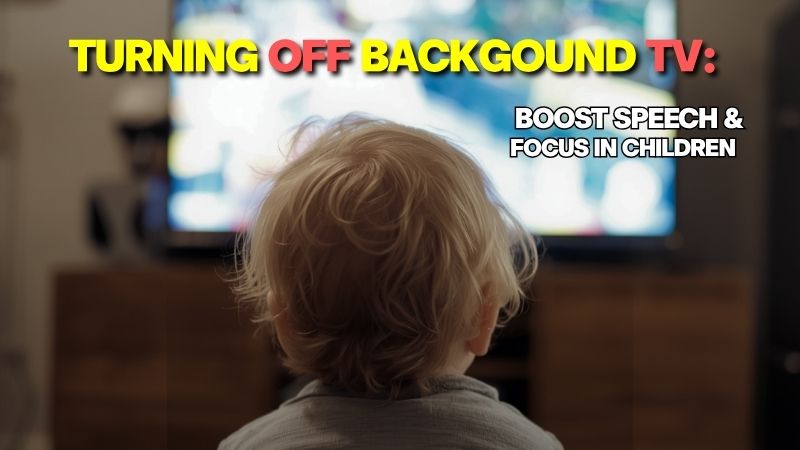
📺 Background TV and Child Development is one of those parenting topics that sounds minor at first, but can quietly shape daily family life. I had many early arguments with my TV-loving husband because the big living room screen was often on until bedtime. Sports, dramas, or random shows kept playing in the background. But I wanted that time to talk about our day and to help our child with language through real conversation. We live in a multilingual home, and I know from experience that language becomes a child’s own language when it is spoken, repeated, and shared with people, not just heard from a screen.
What bothered me most was this: even when no one was “seriously watching,” the TV still seemed to pull everyone’s eyes and attention. The TV sound was often louder than our conversation. And when my child did watch, he sometimes looked so locked in that he seemed to forget hunger, the bathroom, or everything around him. That made me wonder whether background TV was affecting more than I first realized.
According to the Canadian Paediatric Society, high exposure to background TV can negatively affect language use and acquisition, cognitive development, and foundational executive function skills like attention, working memory, and impulse control in children under 5. The CPS also says it can reduce the quantity and quality of parent-child interaction and disrupt play. The AAP similarly notes that regularly having a TV on in the background has been linked with lower language and social-emotional skills in young children.
What is background TV?
Background TV does not only mean a child sitting down and actively watching television. It also includes a TV that stays on in the room while people cook, clean, scroll on their phones, or move around the house. In many homes, it becomes part of the atmosphere rather than something people intentionally watch.
That is exactly why parents often miss it. A child may not be sitting in front of the screen the whole time, so it can feel harmless. But the Canadian Paediatric Society specifically recommends turning screens off when they are not in use and avoiding background TV, because the background media environment itself can affect young children.
Why can it matter even if a child is not really watching?
This is the part many parents do not expect. A child does not need to stare at the screen for background TV to have an effect. Constant sounds, scene changes, and movement in the room can still pull attention away from play, conversation, and daily routines.
The CPS explains that background TV can distract children from play and reduce parent-child interaction. A 2022 study in Pediatric Research also found that certain kinds of background TV exposure were linked with poorer executive functioning in children, especially in common everyday contexts like background TV during play.
So the real issue is not only screen time in the usual sense. It is also the home environment. A screen left on in the background can become a steady source of distraction even when nobody intends it to be.
Hidden effects on language development
This is the part that feels most personal to me. Some people say, “Children learn language from TV.” But that idea is too simple. Children learn language best when words are used with them, not simply around them.
The Canadian Paediatric Society says higher exposure to background TV is known to negatively affect language use and acquisition in children under 5. The AAP also says that overall screen time and regularly having a TV on in the background have been linked with lower language and social-emotional skills in young children.
One reason may be simple: when the TV is on, adults often talk less, listen less carefully, and respond less fully. If the television is louder than the parent, real conversation gets crowded out. And for a child, especially in the early years, real back-and-forth interaction is exactly where language grows strongest.
How background TV can interrupt play and attention
Children do not just play for fun. Through play, they build attention, imagination, patience, and early problem-solving skills. That is why interruptions matter.
The CPS says background TV can interfere with play and may negatively affect foundational executive function skills such as attention, working memory, and impulse control. The 2022 Pediatric Research study on background TV exposure and executive functioning supports the idea that background TV is not just harmless “noise” in the room.
This matters because many parents notice the same pattern at home: a child starts playing, then keeps glancing at the screen, gets pulled out of the activity, and never fully settles into deep play. When that becomes the daily norm, the home can feel more restless, and the child may get less practice staying focused on self-directed activities.
How it changes parent-child conversation
This was one of the biggest reasons I became stricter about TV. Even when we were all together, it did not always feel like we were truly with each other. The television was often taking part in the room too.
The Canadian Paediatric Society says background TV reduces the amount and quality of parent-child interaction. The AAP-backed HealthyChildren guidance also emphasizes that digital media can displace parent-child conversation and that children benefit most when families protect real interaction, play, and shared time.
That is especially important in homes where parents are intentionally trying to build language. A child may hear thousands of words from media, but hearing is not the same as participating. Children learn so much from live interaction, shared attention, eye contact, correction, repetition, and response. Background TV can quietly steal space from all of that.
Why educational videos and background TV are not the same
This is an important distinction. Not all screen use is exactly the same, and parents deserve a balanced explanation.
The AAP says high-quality educational content, especially when parents watch with children and help explain what is happening, can support learning. But that is very different from having a TV playing in the background all day. A co-viewed educational program is intentional. Background TV is passive, constant, and often not even chosen for the child.
And in real family life, the shows children love most are not always educational. Many are fast-paced, character-driven, exciting, or silly. That does not make them automatically terrible. But it does mean parents should not assume that “screen exposure” is helpful simply because a TV is on. When it comes to language, play, and emotional regulation, background TV is not the same as a short, shared, age-appropriate educational activity.
Signs your home may need new TV rules
Background TV can be easy to ignore because it feels normal. But these signs may be worth noticing:
- your child keeps glancing at the screen during play
- you often have to repeat yourself because the TV is on
- the TV is louder than family conversation
- meals, playtime, or evening routines happen under constant TV noise
- your child seems “zoned in” and less aware of hunger, the bathroom, or what others are saying
- the house feels strange or too quiet whenever the TV is off
None of these signs automatically mean something is seriously wrong. But together, they can suggest that the television has become part of the family environment in a way that deserves a second look. The CPS recommends building regular screen-free times, especially for shared family routines like meals and book-sharing.
Practical ways to reduce background TV without guilt
This part matters. Many parents are tired, busy, and overwhelmed. Sometimes the TV is simply what helps a household function for a while. That does not make anyone a bad parent.
So this should not be a guilt-based message. It is better to think in terms of awareness and small changes. The Canadian Paediatric Society recommends turning screens off when they are not being used and creating screen-free family routines. The AAP also emphasizes family rules, co-viewing, and adult modeling.
A few realistic starting points:
- turn the TV off during meals
- turn it off during playtime
- turn it off when your child is telling you about their day
- save sports or adult shows for when the child is asleep or occupied elsewhere
- use music or quiet instead of default TV noise
These are not extreme rules. They are simple ways to give conversation and play a better chance to happen.
A simple family living room rule set
🏡 Sometimes a room rule works better than a child rule.
Here is a simple version many families could use:
- the TV stays off unless someone is actively watching it
- family meals are screen-free
- reading time is screen-free
- playtime is screen-light or screen-free
- if a child watches something, it is chosen intentionally and not just left running
- parents also follow the rule as much as possible
This approach matches the direction of both the CPS and AAP. Children learn not only from what adults tell them, but from what adults normalize every day. If the family rule becomes “we turn on the TV when we choose it,” instead of “the TV is always just on,” that alone can make a meaningful difference.
Quick comparison table
| Area | Home with frequent background TV | Home with less background TV |
|---|---|---|
| Parent-child conversation | Easier to interrupt or half-hear | More natural back-and-forth conversation |
| Child play | More likely to be distracted by sounds and motion | Easier to settle into focused play |
| Language environment | TV sound can compete with real speech | Parent voices and interaction stand out more |
| Family time | Everyone may be together, but attention is divided | Shared time is more intentional |
| House rules | TV can start to feel “always on” | TV becomes something used on purpose |
This table reflects the core concerns highlighted in the CPS guidance and AAP materials: background TV can take space away from conversation, play, and real interaction even when nobody intends that to happen.
Final thoughts
❤️ Background TV and Child Development is not really about whether television is evil. It is about what kind of home environment we are creating.
I am not strict about everything in parenting. But TV is one area where I do believe some rules help. Not because every screen is terrible, and not because every family must do things the same way, but because background TV can quietly take away some of the most valuable parts of childhood: conversation, deep play, shared attention, and real connection.
Parents do not need perfection. They just need to notice what the TV may be replacing. For many families, the biggest change is simple: do not leave it on by default. Turn it on when you want it. Turn it off when you do not. That small shift can create more room for language, focus, and family connection. And for young children, that matters a lot.
Read next :