
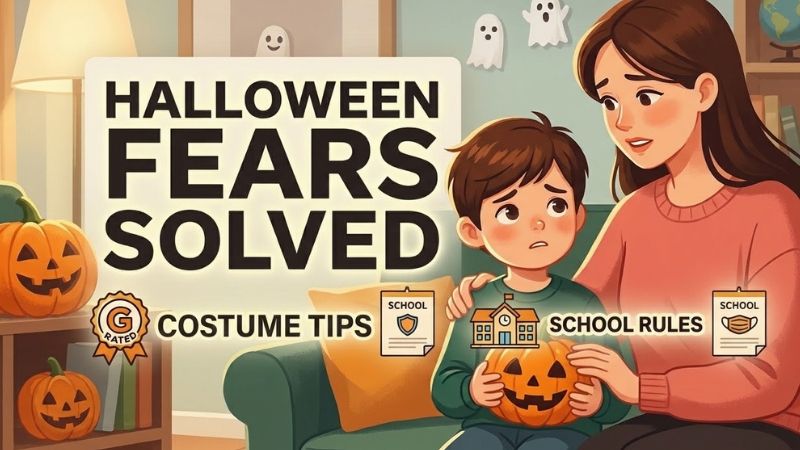
Scary costumes, school rules, and a gentler Halloween for a sensitive five-year-old
Halloween fears in kids feel much more personal when your own child is the one screaming, running away, or crying at a frightening costume.
My child is five and seems more easily frightened than many children the same age. I want us to enjoy Halloween events together. Still, I sometimes wonder: is a little fear okay, or am I choosing something my child is not ready for?
I have also been on the other side. I once bought a scary costume for myself. It frightened my child and their friends, so I stopped wearing it around them.
That experience changed the question for me. Instead of asking how impressive a costume looks, I want to know how the children around it feel.
A brief startle and distress that continues into everyday life deserve different responses. Here is how I would plan a gentler celebration, using child-development guidance and a real Canadian school example.
Why Scary Halloween Costumes Can Frighten Young Children
A five-year-old may enjoy dressing up and still find someone else’s costume overwhelming. Understanding that a monster is pretend does not necessarily make the first sight of it feel comfortable.
The Province of British Columbia’s HealthyMindsBC guidance on childhood fears explains that young children are still learning to separate make-believe from reality. It also notes that strong fears can be difficult for them to override, even when adults offer logical explanations. HealthyMindsBC
That helps explain why “It’s only a mask” may not settle the situation immediately. A hidden face, an unfamiliar voice, and a sudden movement can all arrive at once.
There is no reason to treat a fifth birthday as a deadline for enjoying frightening things. Choose the experience for the child in front of you.
For my family, I would rather begin with a pumpkin activity than assume my child will manage a room full of masked strangers because other five-year-olds enjoy it.
Is a Little Halloween Fear Okay? Watch What Happens Next
Some children enjoy a moment of suspense and then happily ask for more. Others want distance immediately. The useful question is whether the child still wants to participate and can settle with support.
The following is a practical planning guide, not a clinical assessment or a test of emotional development.
| What you notice | A practical response |
|---|---|
| Your child briefly startles, settles, and freely chooses to keep watching | Stay nearby and keep checking whether they want to continue. |
| Your child cries, hides, freezes, runs away, or asks to leave | Move somewhere calmer. Offer comfort and end or change that activity. |
| Fear continues afterward and disrupts ordinary activities, separation, or sleep | Contact a healthcare professional for advice, especially if symptoms persist or worsen. |
A Halloween event does not need to become an exercise in facing fears. If my child is crying and trying to escape, finishing the attraction would no longer be my goal.
Gentle pretend play can be an opportunity to talk about feelings. That is different from claiming that frightening costumes are necessary for resilience or that a haunted house will teach emotional regulation. Those are benefits parents should not assume.
Halloween Costume Rules at School: Masks, Weapons, and Gore
School costume expectations can be stricter than what families see in shops or neighbourhood displays.
For a specific example, Diefenbaker Elementary School’s October 23, 2025 bulletin, from Richmond, British Columbia, asked families to leave masks, weapon-like accessories, and items featuring blood or gore at home. The school explained that these can frighten younger students. It also offered black and orange clothing as an alternative to a costume. Diefenbaker Elementary School
This is one school’s published example, rather than a rule for every school in Canada or the United States. Read your own school’s current notice before buying accessories or sending a costume.
I would check three details:
- Can children wear face paint, hats, or anything that covers their face?
- Are costume props allowed, including toy weapons?
- Is there a simple option for children who prefer not to dress up?
Phrases such as “not-so-spooky” and “G-rated costumes” can suggest a gentler approach. They do not tell you everything about a classroom party or public event. Ask what children will actually see and hear.
How to Plan a Gentle Halloween for a Sensitive Child
The American Academy of Pediatrics’ Halloween advice for babies and toddlers recommends preparation, practising costumes, earlier activities, and being ready to finish early. It also says that choosing not to participate is okay. HealthyChildren.org
That resource is written for younger children. I would use these ideas as a starting point for planning with my sensitive five-year-old, rather than treating it as a readiness checklist for that age.
Before the Event: Ask About Surprises and Exits
“Family-friendly” would not be enough information for me to book an unfamiliar attraction. I would ask:
- Are there actors who approach or chase visitors?
- Do decorations move suddenly or make loud sounds?
- Are there dark enclosed spaces, flashing lights, or frightening masks?
- Is there a quieter daytime session?
- Can we leave easily without finishing the whole route?
For example, I might tell an organizer: “My child is five and gets frightened by masks and sudden noises. Is there a session without jump scares?”
I would also offer two manageable choices, such as pumpkin decorating or a short costume walk. That gives my child a say without asking them to judge an attraction they have never seen.
During the Event: Make Stopping Easy
Before arriving, I would agree on a simple phrase: “I need a break.” My child could use it without having to explain everything in a noisy crowd.
If a costume frightens them, I would first move away and get down to their level. A short response might be: “That surprised you. I’m here. We can stand over there.”
Once they are calmer, I could explain that someone is wearing a costume. I would avoid asking that person to come closer to prove it, unless my child clearly wanted that.
I would also resist comparing reactions with friends. “Everyone else is having fun” would not help me understand what my own child needs.
After the Event: Leave Room for an Ordinary Evening
My plan would include time to get home, change clothes, and return to our usual evening routine. I would rather visit fewer houses than squeeze in one more attraction when my child has had enough.
For an at-home alternative, we could decorate paper pumpkins, wear a favourite outfit, or have a small Halloween snack together. Handing out treats is another option only if visiting costumes feel comfortable; it is not automatically the gentler choice.
These are activity ideas, not a promise that any particular plan will prevent fear or bedtime worries.
Choosing a Costume That Feels Comfortable and Is Safe
My own costume mistake taught me to think about the audience, including children who are younger or more easily frightened.
For now, I would choose something with a visible, familiar face: a simple animal outfit, a storybook character, or a festive hat. That is my preference for our situation, not a guarantee that every child will find those options reassuring.
Physical safety matters too. Health Canada’s Halloween safety guidance recommends well-fitting costumes, bright or reflective materials, and face paint instead of masks where possible. It advises patch-testing makeup, choosing soft accessories, keeping children away from flames, and supervising young trick-or-treaters. Canada.ca
For a Canadian evening, I would try the outfit on with the warm layers and shoes my child will actually wear. A costume needs to work for walking outside, not just for a photograph indoors.
When Halloween Worries Affect Bedtime or Everyday Life
A frightening moment does not, by itself, tell a parent whether a child has a mental health condition. Continuing disruption is a reason to seek advice rather than keep guessing.
In a Child Mind Institute response about a four-year-old frightened by a Halloween store, clinical psychologist Rachel Busman explains that the concern was the ongoing effect on ordinary functioning. The child had become unusually clingy and stopped enjoying usual activities. She recommended professional support. Child Mind Institute
If my child developed repeated bedtime distress, persistent difficulty separating, or avoidance that spread into everyday life, I would discuss it with our family doctor, nurse practitioner, or a qualified child mental health professional. I would seek help sooner if the distress were severe.
Skipping an optional attraction can be a sensible choice for the evening. Fear that continues to restrict daily life needs more attention than simply avoiding Halloween next year.
Halloween Fears in Kids: Your Questions Answered
Should I Encourage My Five-Year-Old to Try a Haunted House?
For the reactions I see in my own child, I would begin elsewhere. I would choose a predictable activity, ask about the environment, and keep leaving easy. Being five would not be my reason to book a haunted attraction.
What If My Child Wants to Go but Gets Scared on Arrival?
I would allow the plan to change. Looking forward to an event at home and feeling comfortable inside it are different things. We could watch from a distance, take a break, or leave.
Should Parents Avoid Scary Costumes Too?
In my case, yes. My costume frightened my child and their friends, so I stopped wearing it around them. An adult’s outfit is an easy part of the celebration to adjust.
What If My Child Has a Nightmare After Halloween?
If my child woke frightened, I would comfort them, explain that the dream is over, and help them settle back into our familiar bedtime routine. I would not turn that moment into another lesson about being brave.
One dream would not give me enough information to decide what caused it. Repeated nightmares or bedtime distress would be something to discuss with a healthcare professional, especially alongside changes during the day.
The Halloween I Want My Child to Remember
I still want to share the costumes, pumpkins, and neighbourhood excitement with my child. I also want there to be room for a smaller celebration when that feels better.
For this Halloween, my goal is simple: choose something we can enjoy together, listen when my child needs a break, and let the evening finish before it becomes too much.
By Grace Shin, a mother living in Canada. This article combines personal experience with linked public guidance. It provides general parenting information, not an individual clinical assessment. Sources checked October 22, 2026.
Read next: