
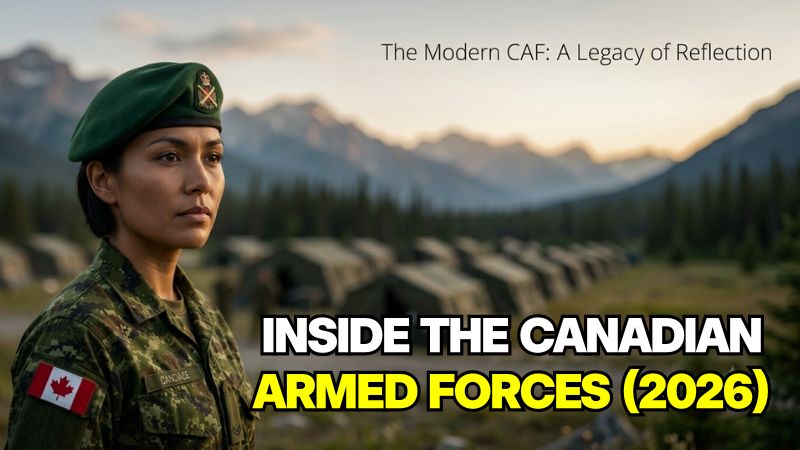
A Clear Guide to CAF Personnel, Military Pay, Benefits and Permanent Resident Eligibility
By Grace Shin | Reviewed September 18, 2026
I started looking up Canadian military numbers after a few small moments here in Richmond, BC. I occasionally see someone in uniform, and passing a military training facility has made me wonder what happens beyond the entrance. How many people choose this career? What does military life offer them and their families?
As a Korean living in Canada, I also think about the Canadian troops who helped South Korea during the Korean War. That history gives the subject a personal connection, even though my questions began with everyday curiosity.
Here is what I found, with the dates and definitions that make the figures easier to understand.
In this guide
- How many people serve in the CAF?
- Why do personnel totals differ?
- Is service compulsory, and how do the reserves work?
- How much do Canadian military members earn?
- What benefits do members and families receive?
- Can permanent residents join?
- What connects Canada’s military to the Korean War?
- What do these figures mean in everyday life?
How Many People Serve in the Canadian Armed Forces?
A dated 2026 National Defence snapshot reported approximately 67,800 Regular Force members and 32,408 Primary Reserve members. These figures describe the position at the end of March 2026; they are not a live September headcount.
The same briefing also reported approximately 25,100 Primary Reserve members using a different measure: Average Paid Strength.
| Personnel measure | Reported figure | How to read it |
|---|---|---|
| Regular Force strength | Approximately 67,800 | The full-time military component |
| Primary Reserve total strength | 32,408 | The total membership reported for this reserve component |
| Primary Reserve Average Paid Strength | Approximately 25,100 | A separate measure of paid participation, not additional personnel |
National Defence separates these measures in its 1. April 2026 briefing on CAF recruitment and retention.
Adding the Regular Force figure to Primary Reserve total strength gives roughly 100,200 people across those two components. This is an approximate calculation using a rounded Regular Force figure. It does not include every other reserve subcomponent.
Why Do Canadian Armed Forces Personnel Figures Differ?
The most useful question is: What exactly is this source counting?
A headcount counts members. A paid-strength measure reflects paid participation. An authorized strength describes the staffing level an organization is permitted to maintain. A future expansion target describes a goal.
Those figures answer different questions. They cannot be substituted for one another.
For example, the Primary Reserve’s total strength and Average Paid Strength in the table are two views of the same component. Adding them together would double-count people.
Similarly, a figure for the Canadian Army alone is not a total for the whole military. The CAF also includes the Royal Canadian Navy, Royal Canadian Air Force and joint organizations. The wider Reserve Force includes categories beyond the Primary Reserve, such as the Canadian Rangers and Supplementary Reserve.
When comparing two articles, check three things before deciding that their numbers conflict:
- The date: Were the figures collected in the same month or year?
- The population: Regular Force, Primary Reserve, or a broader grouping?
- The measure: Total membership, paid strength, trained strength, or a target?
This distinction was the most helpful part of my research. A number becomes much more useful once its label is clear.
Is Military Service Compulsory in Canada?
Canada currently has a volunteer military. People choose to apply; there is no general requirement to complete military service like the system familiar to many South Koreans.
Here, “volunteer” describes the decision to join. It does not mean unpaid work.
Regular Force vs. Primary Reserve
| Question | Regular Force | Primary Reserve |
|---|---|---|
| Is it usually a full-time career? | Yes | Many members serve part time; full-time service opportunities also exist |
| Can members have another job or attend school? | Military service is their main employment | Many combine service with civilian work or studies |
| What about location? | Postings can require relocation | Members commonly serve with a local unit, with training or duties elsewhere |
| Are pay and benefits identical? | Regular Force rules apply | Entitlements depend on the type and length of reserve service |
For someone in Richmond, the reserve option may raise a practical question: could military service fit alongside an existing job or education?
That is a useful starting point for a recruiting conversation. Ask about the actual training calendar, travel requirements and available positions. A local unit does not guarantee that every course or duty will take place close to home.
How Much Do Canadian Military Members Earn?
The published entry monthly rate for a Regular Force Private is CAD $4,337 before deductions. The official table reviewed for this article lists rates effective April 1, 2025.
| Rank and published pay step | Gross monthly pay | Monthly rate × 12 |
|---|---|---|
| Private — entry step | $4,337 | $52,044 |
| Private — next published step | $4,987 | $59,844 |
| Private — third published step | $5,994 | $71,928 |
| Corporal — standard, starting step | $6,858 | $82,296 |
The annual column is simple arithmetic, not a prediction of an individual’s first-year earnings. The figures come from 2. National Defence’s Regular Force pay tables.
Do Recruits Get Paid During Training?
Yes, but there is no single training salary for every entry route. Rank, entry plan and applicable pay level matter. Officer cadets have separate rates, and part-time reserve service uses different pay arrangements.
A Private’s three published steps should not be presented as three guaranteed stages within basic training.
These are gross amounts, before taxes and other deductions. They also do not represent every possible allowance. For household budgeting, ask for the applicable starting rate and expected deductions, rather than treating a headline salary as take-home pay.
CAF Benefits: Health Coverage, Leave, Pension and Education
The benefits are substantial, but the details depend on service status and eligibility. National Defence’s 3. military benefits directory connects readers to its medical, dental, annual-leave and parental-benefit rules.
Paid Annual Leave
Under the CAF Leave Policy Manual effective April 1, 2025, the annual entitlement progresses from 20 working days to 25 after five years of service, and 30 after 25 years. Partial years and different service arrangements can affect the amount earned.
These are working days, not calendar days. Leave still requires approval and must fit operational requirements.
Medical and Dental Benefits for Members and Families
Eligible members receive care through the CAF’s medical and dental system. Family coverage follows different arrangements, including provincial or territorial health coverage and applicable supplementary health and dependant dental plans.
Family benefits do not mean every treatment is automatically free. Eligible expenses, reimbursement limits and enrolment requirements still matter.
For a family comparing career options, useful questions include which dependants qualify, when coverage begins and what expenses remain out of pocket.
Maternity and Parental Benefits
The CAF’s parental-benefit guidance describes support that can bring eligible income to 93% of pay and specified allowances under applicable maternity or standard parental arrangements. The corresponding rate under extended parental arrangements can be 55.8%.
These arrangements coordinate with EI or Quebec’s parental insurance system. They are not an extra 93% payment on top of full government benefits. Eligibility, benefit duration and return-to-service conditions apply.
The distinction matters when planning a family budget: a longer leave option does not mean the same weekly replacement rate for the entire extended period.
Pension and Paid Education
CAF pension arrangements can provide retirement income based on the applicable plan, earnings and qualifying service. Members contribute; joining does not immediately create entitlement to a full pension.
Paid education programs can cover approved study costs, including tuition and required materials, while participants receive pay. However, these programs come with conditions and service obligations.
Before choosing a program, ask how long you must serve afterward and whether leaving early could trigger repayment. Those details are just as important as the advertised tuition support.
Can Permanent Residents Join the Canadian Military?
Yes, but permanent resident status alone is not the whole eligibility test.
National Defence’s 2026 recruitment update says applicants must be Canadian citizens or permanent residents with at least three years of physical presence in Canada. The backgrounder describes the updated requirement in relation to physical residency as a permanent resident.
This is an important correction to older articles that simply say, “PR holders can join.” National Defence reports that the eligibility requirements changed on February 23, 2026.
The same update reports 1,400 permanent resident enrolments in fiscal year 2025–26. You can check the wording in 4. National Defence’s 2026 recruitment and permanent resident update.
If your time in Canada includes years before becoming a permanent resident, ask the recruiting office how your residence history is assessed. Do not assume those years automatically satisfy the updated condition.
Eligibility also does not guarantee a job offer. Applicants still need to meet the requirements for their chosen occupation and complete the recruitment process.
Canada and the Korean War: Why Kapyong Still Matters
For me, this topic has a connection beyond career information. I had heard about Canadian soldiers helping South Korea long before I began researching their present-day military.
At the Battle of Kapyong in April 1951, the 2nd Battalion, Princess Patricia’s Canadian Light Infantry helped hold a defensive position during a major offensive. Their actions helped prevent a potentially costly defeat for South Korean and United Nations forces.
Veterans Affairs Canada records 10 Canadians killed and 23 wounded at Kapyong. The battalion received the United States Presidential Unit Citation. Those who died there were among the 516 Canadians who died in service during the Korean War.
These details are documented in 5. Veterans Affairs Canada’s history of the Battle of Kapyong.
Living in Canada makes that history feel closer. When I see a military uniform here, I think about the connection between the country I came from and the country where I now live. Learning about Kapyong gives that connection a name, a place and people to remember.
Canadian Military Numbers: The People Behind the Figures
My curiosity started with an occasional uniform in Richmond and questions about a training facility. It led to a better understanding of full-time careers, reserve service and the families behind them.
If you are researching a military career, I would bring five questions to a recruiter: Which entry plan applies to me? What would my starting pay be? Where would I train and work? Which family benefits would apply? What service commitment would I make?
If you are simply curious, as I was, start with the date and definition beside each statistic. They help turn a confusing collection of numbers into a clearer picture of the people serving Canada.
About the author: Grace Shin is a Korean writer living in Richmond, BC, who writes about everyday life in Canada. This article combines her personal observations with publicly available government information.
Read next :