
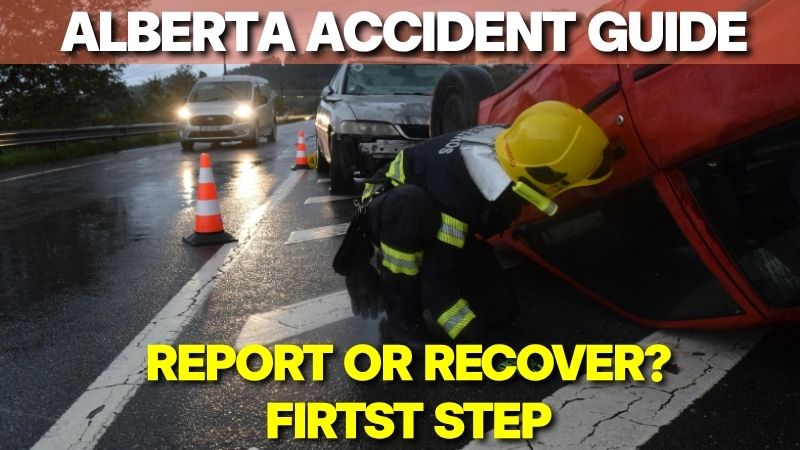
Car accident in Alberta can feel like two emergencies at once.
First, the crash itself.
Second, the panic of not knowing what to do next in a place that may still feel unfamiliar.
If you are a newcomer, a nervous driver, or someone still getting used to Alberta roads, I truly get why this can feel overwhelming. Your heart drops. Your mind goes blank. Even simple English can disappear for a minute. 🚗
But here is the good news: you do not need to solve everything at once.
The order matters more than perfection.
Check people first. Move to safety if possible. Exchange information. Find out whether the crash must be reported. Then contact your insurer.
That is the clearest way to steady yourself after a collision.
Quick guide at a glance
| Situation | What to do first | Why it matters |
|---|---|---|
| Someone is injured | Call 911 right away | Safety always comes first |
| Damage may be over $5,000 | Report it to police as required | Alberta reporting rules may apply |
| Single-vehicle crash | Document the scene and check if it is reportable | Single-vehicle crashes can still require reporting |
| Minor property damage only | Exchange details and notify your insurer quickly | Good records protect you later |
| You feel “fine” but sore later | Monitor symptoms and get medical advice | Pain can appear after the shock fades |
Alberta’s official post-collision guidance, along with Calgary and Edmonton police reporting rules, all follow this same practical flow: protect people, document the crash, and report it properly when required.
What to do first after a car accident in Alberta
The first job is not checking the bumper.
It is checking people.
If anyone is hurt, call 911. If the vehicles are creating a danger and can be moved safely, deal with safety first. Alberta’s official collision worksheet is one of the best simple tools to keep bookmarked or printed in your car because it focuses on the information people actually forget in stressful moments: names, vehicle details, insurance information, witness details, and the basic facts of the crash. See the official What to Do After an Auto Collision worksheet.
This is also the moment to slow your emotions down. You do not need a perfect speech. You do not need to argue fault at the roadside. You just need to stay calm enough to protect yourself and collect the right facts.
When do you have to report an accident in Alberta?
This is one of the biggest questions people search after a crash.
In Calgary, police say you must report a collision if anyone is injured, damage exceeds $5,000, or you are the victim of a hit and run. You can check the city’s official guidance on the Calgary Police traffic and collision reporting page.
Edmonton Police give very similar guidance. They say that if the involved vehicles have $5,000 or more in combined damage, you must report the collision to a Collision Reporting Centre as soon as possible, and failure to report may result in a fine. Their official instructions are on the Edmonton Police collision reporting page.
So the simple takeaway is this: if there is injury, hit and run, or significant damage, do not delay.
Reportable collisions should be handled as soon as possible.
Do you have to report a single-vehicle accident in Alberta?
Yes, sometimes you do.
A lot of drivers assume that if only their own car was involved, it is “not really an accident” in the reporting sense. But that is not how it works. A single-vehicle crash can still involve a guardrail, pole, animal, ditch, fence, or other property damage. It can also still cross the reporting threshold depending on injuries or damage. Calgary Police specifically treats collisions with other objects as traffic collisions, not as something you simply ignore.
That is why this question matters so much: single-vehicle does not automatically mean no report.
You still need to check whether the crash is reportable based on the actual facts.
How Report My Collision works in Alberta
If your collision fits the eligible categories, Alberta’s official Report My Collision service can be a very helpful option. It is designed as an online alternative to some in-person collision reporting processes. Alberta’s support fact sheet says drivers access it through an Alberta.ca account, and the service is meant for certain types of collisions rather than every possible crash.
This is helpful because after a crash, many people are not asking for legal theory. They are asking, “Can I do this online, or do I have to go somewhere in person?” The answer depends on where the collision happened and what kind of collision it was. That is exactly why checking the official reporting route matters.
What information should you collect at the scene?
This part can save you from so much stress later.
Try to collect:
- full name of the other driver
- contact details
- driver’s licence number
- licence plate number
- vehicle year, make, model, and colour
- insurance information
- exact location of the crash
- witness names and contact details
- clear photos of damage and the wider scene
Edmonton Police specifically recommends recording the location, plate number, vehicle details, driver details, registered owner details if different, witness details, and photos of the scene and damage. Alberta’s official worksheet is built around the same idea. Photos and facts are your best friends after the adrenaline wears off.
When should you call your insurance company?
You should contact your insurer promptly. The Insurance Bureau of Canada says it is important to report the collision to your insurer within 48 to 72 hours, even if you have not fully decided whether to file a claim. They also recommend documenting details, photos, road conditions, and witness information right away because those details become harder to remember later.
So even if you are still shaken, this is the safer mindset:
police reporting rules and insurance reporting are not the same thing.
A collision can be reportable to one system and still require prompt notice to your insurer as well.
Why you should not ignore pain after a crash
Some people feel “okay” right after a collision and only start hurting later that night or the next day. That delay is very real.
Back pain, neck pain, numbness, tingling, leg weakness, or pain that gets worse when standing or walking should not be brushed off too quickly. Spinal stenosis is a narrowing of spaces in the spine that can put pressure on nerves. Mayo Clinic says the most common cause is age-related wear and tear, but it also notes that car accidents and other trauma can cause spinal bones to break or move out of place, which can add pressure on the spinal cord or nerves. Cleveland Clinic likewise explains that injuries, fractures, inflammation, and disk problems can contribute to narrowing and nerve symptoms.
That means the honest answer to “Can a car accident cause spinal stenosis?” is not a simple yes or no. In many people, stenosis is mainly related to degeneration over time. But a crash can trigger symptoms, worsen an existing problem, or reveal a condition that had not been diagnosed yet.
If pain, tingling, numbness, or weakness keeps showing up after the accident, get proper medical advice instead of just hoping it will disappear.
How to get an Alberta Collision Report
If you later need a copy of the report, Alberta offers an official request page for that. You can request it through the government’s Alberta Collision Report service. The site states that if you were involved in a traffic collision in Alberta, you may request a copy of the Alberta Collision Report, and it lists the cost and access requirements. It also notes that Alberta Transportation may not receive the original report for several months after the collision date.
That last point matters. Sometimes people panic because they cannot find the report immediately. But delay in availability does not automatically mean something went wrong.
Before you search settlement payouts
This is the part many people think about quietly.
After a crash, it is very normal to search things like settlement payouts, average claims, or “how much is my case worth?” But before any of that, the smarter first move is to protect your records:
photos, symptoms, treatment notes, police file information, repair details, and insurer communication.
Those things matter more in real life than random numbers on the internet. A claim is rarely decided by one average figure. It is shaped by the actual facts of your case, your injuries, your policy, and the documents you kept.
Final thoughts
If car accident in Alberta is the problem sitting in front of you right now, try to hold on to this:
You do not have to do everything at once.
You just need the right order.
People first. Safety second. Information third. Reporting next. Recovery after that. 💛
That order is simple, but when you are shaken, simple is powerful. Your car can be repaired. The paperwork can be handled one step at a time. What matters most is staying calm enough to protect yourself, document what happened, and get support when you need it. Official Alberta and police guidance all point in that same direction.
If you want, I can turn this into a WordPress-ready final post format next, with a cleaner intro hook, FAQ schema-style Q&A, and a thumbnail text suggestion.
READ NEXT: