
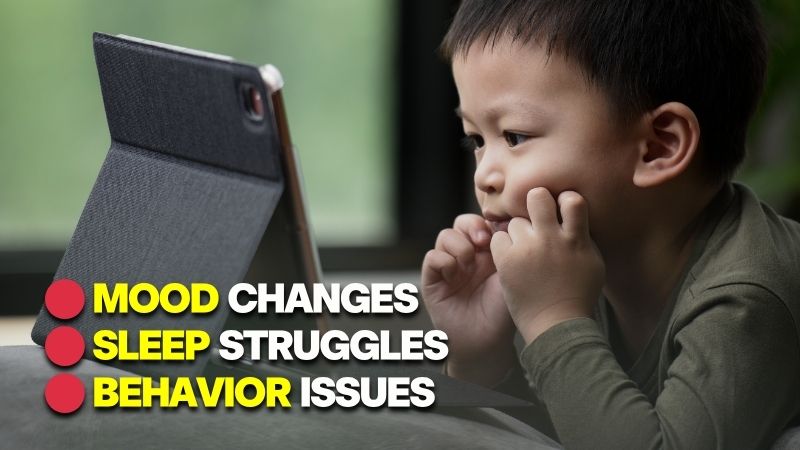
📱 Screen Time and Young Children is one of those parenting topics that sounds simple at first, but feels much more complicated in real life. As parents, we know how helpful a screen can be when we need to cook dinner, finish a task, or just get through a restaurant meal in peace.
I also think many adults feel the effects of too much screen time themselves. We feel tired, overstimulated, distracted, or irritable after staring at screens for too long. So it makes sense to wonder whether young, developing children may be affected even more.
And honestly, this is something many of us see all the time. At restaurants, in waiting rooms, or in public spaces, it is common to see children watching a tablet for a long stretch of time. I completely understand why parents do it. Sometimes we just need a few calm minutes to eat. But it is still worth asking an important question: what happens when screens become a regular part of how children eat, calm down, fall asleep, or get through boredom?
The good news is that this topic does not need fear or guilt. It needs clear, realistic guidance. According to the Canadian Paediatric Society, the CDC, the World Health Organization, and the AAP’s parenting resource Helping Kids Thrive in a Digital World, the issue is not only how long a child watches. It is also when, what, how, and what screen time is replacing—such as sleep, outdoor play, reading, conversation, and family connection.
Does Screen Time Really Affect Mood, Sleep, and Behavior?
Yes, it can.
That does not mean every child who watches a screen will have problems. But official child health guidance consistently shows that heavy or poorly timed screen use can affect the areas parents often notice first: mood, sleep, behavior, attention, and daily routines.
For children under 5, experts keep coming back to the same concern. Screen habits can affect sleep, language, self-regulation, and the time children spend interacting with adults and the world around them. The AAP also notes that misuse of digital media in early childhood can be linked to unhealthy sleep, more angry outbursts, and fewer chances to build patience and self-control.
Sleep is one of the clearest warning areas. Both Canadian and U.S. guidance emphasize that screens close to bedtime can make it harder for young children to settle, fall asleep, and get enough rest.
Behavior can also change in ways parents notice quickly. Some children become more irritable after screen time. Some struggle when it is time to stop. Others seem fine during the screen, but melt down afterward. That pattern does not always mean screens are the only cause, but it is often a sign worth paying attention to.
Why Young Children Are More Sensitive to Screen Time
Young children are still building the core skills that help them handle everyday life. They are learning how to regulate emotions, wait their turn, manage frustration, develop language, and stay focused long enough to listen, play, and learn.
The preschool years are a major stage for social, emotional, behavioral, and language development. That is one reason health guidance keeps stressing that young children need more than passive entertainment. They need conversation, movement, play, and real interaction with caring adults.
That is why the real concern is not always the screen itself. The bigger concern is what screen time may be crowding out. If a child spends long stretches on a tablet, that time may be replacing conversation, pretend play, movement, reading, shared meals, or outdoor time. WHO frames this as part of a full 24-hour balance that includes activity, sedentary time, and sleep.
Even background TV can matter. Families sometimes focus only on “active watching,” but experts also recommend turning screens off when they are not being used, including background TV, because it can interfere with routines, attention, and interaction.
Signs Your Child May Be Getting Too Much Screen Time
Every child is different. But some patterns are worth watching.
Your child may be getting too much screen time if you notice:
- more irritability after watching
- strong meltdowns when the screen is turned off
- difficulty falling asleep or resisting bedtime
- needing a screen to eat, calm down, or sit still
- less interest in books, toys, or outdoor play
- more whining, boredom, or restlessness without a device
- trouble transitioning back to normal routines
These signs do not automatically mean screens are the only cause. But they are good reasons to pause and look at the bigger pattern. Parents often see the problem first when a child cannot sleep well, cannot focus, or cannot step away from screens easily.
What Do Official Guidelines Say?
Official guidance is actually more practical than many parents expect. The goal is not perfection. The goal is balance.
The Canadian Paediatric Society recommends that for children ages 2 to 5, routine or regular screen time should be limited to less than 1 hour per day, and screens should be avoided for at least 1 hour before bed. The CDC also recommends keeping TVs out of the bedroom and limiting preschool screen time to no more than 1 hour per day of quality programming. WHO emphasizes that screen habits should fit within a healthy daily balance of movement, rest, and limited sedentary time. The AAP focuses on quality, context, conversation, co-viewing, and family routines, not just counting minutes.
Quick Comparison Table
This quick table makes the major guidance easier to compare at a glance.
| Source | Age Group | Main Guidance | What Parents Can Take Away |
|---|---|---|---|
| Canadian Paediatric Society | 2–5 years | Limit routine or sedentary screen time to about 1 hour or less per day; keep meals and book-sharing screen-free; avoid screens at least 1 hour before bed | Focus on sleep, shared routines, and reducing passive screen habits |
| CDC | 3–5 years | Preschool years are critical for social, emotional, language, and behavioral development; avoid screens in bedrooms and limit screen time to quality programming | Protect bedtime and support development with play, reading, and interaction |
| WHO | Under 5 | Screen time should fit within a healthy 24-hour balance of activity, rest, and limited sedentary time | Screen time should not replace sleep or movement |
| AAP | Children and families | Focus on quality, context, conversation, and what media is crowding out; use a Family Media Plan | Shared devices, co-viewing, family rules, and screen-free zones matter |
Can Educational Videos Ever Be Helpful?
Yes—but with important conditions.
This is where many parents feel confused. We hear that screen time can be harmful, but we also see educational videos, alphabet apps, and language content everywhere. So what is the truth?
The short answer is this: quality matters, and interaction matters. Canadian guidance recommends educational, age-appropriate, interactive content, and says adults should be present and engaged when screens are used. The AAP also encourages families to choose quality content and, whenever possible, watch or play alongside children.
But “educational” does not automatically mean “good in unlimited amounts.” Timing still matters. Quantity still matters. And the child still needs real-world conversation, books, movement, and play.
So yes, an educational video can be helpful. But it is usually most helpful when it is short, high-quality, age-appropriate, and shared with an adult.
Why Tablets at Restaurants Feel Helpful—But Can Backfire
This is one of the most relatable screen-time situations for parents.
A tablet at a restaurant can feel like a lifesaver. The child stays quiet. The adults can eat. Everyone gets a break. And sometimes, that one peaceful meal really does matter.
But when this becomes a regular habit, it can slowly teach children that eating, waiting, or sitting still always needs screen entertainment. Canadian guidance specifically recommends building screen-free meal times, and the AAP also reminds parents that children copy adult habits, especially around everyday routines like meals and bedtime.
Meals are not only about food. They are also where children practice conversation, patience, trying new foods, and reading social cues. The more often a screen takes over that space, the fewer chances they have to build those small but important skills.
That does not mean parents should feel guilty for every restaurant tablet. It just means it should stay the exception, not the rule.
How to Cut Back Without Daily Battles
The hardest part is usually not knowing what to do. It is doing it without a huge meltdown.
A sudden “no more screens” rule often fails because it leaves a big empty space in the day. A more realistic approach is to change where and when screens happen first. The AAP’s Family Media Plan is helpful because it focuses on routines, boundaries, and family values—not just punishment.
7 Realistic Rules That Actually Help
1. Keep meals screen-free.
This protects conversation and helps children learn to sit, eat, and connect without constant entertainment.
2. Stop screens before bedtime.
Aim for at least 1 hour before bed. For some children, even earlier may work better.
3. Do not keep screens in the bedroom.
This is one of the simplest ways to protect sleep.
4. Choose shared screens over personal screens.
Shared devices make co-viewing easier and help parents monitor what children are watching.
5. Turn off autoplay.
Many platforms are designed to keep children watching longer than parents intended.
6. Replace the screen with something specific.
Children do better when “no screen” is followed by an alternative: coloring, books, blocks, sticker books, music, outdoor play, or pretend play.
7. Model the behavior you want to see.
Children notice everything. If we want less screen dependence from them, we also need to show healthier boundaries ourselves.
💡 The goal is not to make family life harder. The goal is to make screens less powerful in the moments that matter most.
When Parents Should Talk to a Doctor
Sometimes screen habits are mainly a routine issue. But sometimes they overlap with bigger concerns.
It may be worth bringing it up with your pediatrician or family doctor if your child has:
- ongoing sleep problems
- very intense meltdowns tied to screen use
- noticeable language delays
- attention concerns that feel bigger than expected
- strong dependence on screens to calm down
- developmental concerns in play, speech, behavior, or social interaction
The CDC encourages parents to keep track of developmental milestones and talk with a doctor if they are worried about development. If screen-related struggles seem to be affecting sleep, communication, or daily functioning in a bigger way, that is a good reason to ask for help.
Official Resources for Parents
If you want to keep a few reliable resources in the post, the five official sources already linked above are the best ones to start with:
- Canadian Paediatric Society
- CDC
- WHO
- AAP: Helping Kids Thrive in a Digital World
- AAP Family Media Plan
These are especially useful because they combine official recommendations with practical parenting advice.
Final Thoughts
Screen Time and Young Children is not a topic that needs panic. It needs honesty, balance, and a plan that works in real family life.
Most parents do not need perfection. They need clear signs to watch for and realistic ways to protect the most important parts of childhood: sleep, play, movement, language, family connection, and emotional regulation.
If screens are starting to affect your child’s mood, sleep, or behavior, that does not mean you have failed. It usually means it is time to reset the routine, tighten a few boundaries, and bring more offline connection back into the day.
And in most homes, that is where the real change begins.
Read next :