
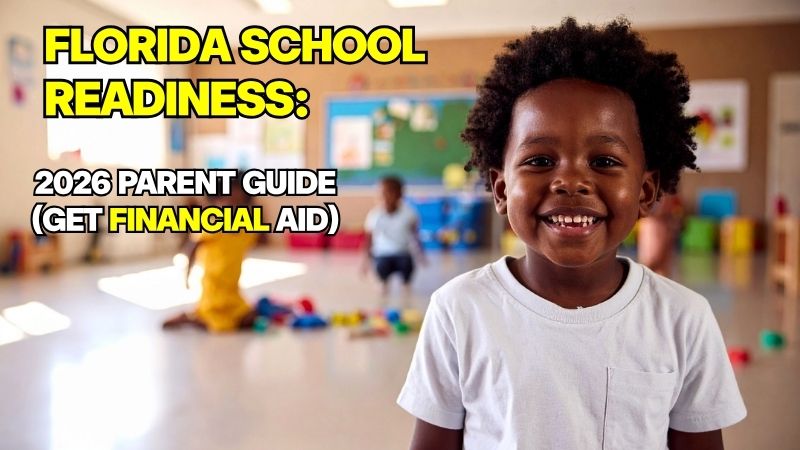
Florida Child Care Assistance can feel confusing at first, especially because Florida usually calls its main child care subsidy program School Readiness, or SR. 🌴 If you are a parent trying to balance work, school, bills, and child care, that little naming difference alone can make the search much harder than it should be. As a mom, I know how exhausting it feels to squeeze in this kind of research between diaper changes, meals, and nap schedules. That is exactly why this guide matters. According to the Florida Department of Education, School Readiness offers financial assistance to eligible low-income families for early education and care, and families apply through the state’s Family Portal.
Florida may be a wonderful place to raise a child, but the cost of care can still weigh heavily on parents. The good news is that the help many families are searching for does exist. In Florida, the child care assistance parents often mean is usually School Readiness. The state says the program helps families pay for early education and care so parents can work, train, or study while children build school-readiness skills.
For the official program overview, start here: Florida DOE – What Is School Readiness?
Why Child Care Costs Feel So Heavy in Florida
Child care is not a small extra expense for most families. It can shape whether a parent keeps a job, returns to school, or even takes on more work hours. That is one reason Florida frames School Readiness as both a family-support and school-readiness program. The state says SR helps eligible families become financially self-sufficient while helping young children succeed in school later on.
So if you have been asking questions like Do I qualify?, How do I apply online?, or Is it free?, you are asking the right questions. Those are exactly the questions most parents need answered first.
What Is Florida Child Care Assistance, and Why Is It Called School Readiness?
This is the first thing to clear up.
In Florida, “child care assistance” usually refers to School Readiness (SR). The Florida Department of Education says SR offers financial assistance to eligible low-income families for early education and care. The program is administered at the state level and delivered through 30 local early learning coalitions statewide plus RCMA, which is why families often see both state pages and county-based coalition pages when they search for help.
That means this simple equation is usually true:
Florida Child Care Assistance = Florida School Readiness
If you were worried that you were looking at the wrong program because it did not literally say “child care subsidy,” you were probably already in the right place.
Who Qualifies for Florida School Readiness in 2026?
Parents usually want the same answer first: Do I qualify?
Florida’s School Readiness pre-qualification tool asks whether you have a child younger than 13 who needs care, your household size, your gross income before taxes, and whether you meet one of several care-related conditions. Those conditions include being a single parent employed or attending school at least 20 hours per week, being a two-parent family working or attending school a combined 40 hours per week, or being exempt from work because of disability. The Florida DOE also says parents must be working or participating in an educational activity such as college or trade school at least 20 hours per week, and other children may qualify under special circumstances such as special needs, homelessness, domestic violence, or other risk factors.
So the real answer is not just about income. It is usually about this combination:
- your child’s age
- your household’s gross income
- and why you need care
That is what makes Florida’s program feel more specific than a simple one-line benefit.
What Is the Income Limit for Child Care Assistance in Florida?
This is one of the most searched questions, and it deserves a very clear answer.
Florida’s official School Readiness and School Readiness Plus At-a-Glance document says the initial qualifying rule for SR is gross family income at or below 55% of state median income, with subsequent income at or below 85% of the state median income for ongoing eligibility. It also shows that SR Plus is a separate state-funded program for certain families who lose SR because they become over-income but still meet other criteria.
For a parent-friendly example of what the 55% SMI numbers look like in practice, the Early Learning Coalition of Broward County currently lists these annual gross income figures:
| Household Size | Annual Gross Income Example |
|---|---|
| 1 | $29,476 |
| 2 | $38,546 |
| 3 | $47,615 |
| 4 | $56,685 |
| 5 | $65,754 |
The key word here is gross. That means income before taxes. Florida’s pre-qualification page also frames the question in gross annual household income terms, not take-home pay.
For the state’s official side-by-side program summary, see: Florida DOE – School Readiness and SR Plus At-a-Glance (PDF)
How to Apply for Florida Child Care Assistance Online
This is the part parents usually need most.
Florida’s official Family Portal says families can apply for School Readiness online, and the Florida DOE directs parents to use that portal to apply for services.
Use the state portal here: Florida Early Learning Family Portal
Step 1: Create your Family Portal account
Start by creating or signing into your Family Portal account. The portal is the official entry point for School Readiness applications.
Step 2: Start a School Readiness application
Once inside, begin a new School Readiness application. Florida’s pre-qualification tool is also useful if you want a quick first-pass check before completing the full process.
Step 3: Upload the right documents
Some local coalitions explain the practical side very clearly. For example, Florida’s Gateway coalition says families applying for the waitlist or School Readiness should upload proof of employment of 20 hours or more a week, a current school schedule of 10 hours or more, or a disability award letter, depending on the family’s situation.
Step 4: Watch your email
Florida’s Gateway coalition says families will receive an email if the application is accepted or rejected, and Broward says families should allow staff up to 20 calendar days to follow up with next steps.
This is where many parents get stuck. The application itself is online, but the follow-up can still depend on your local coalition’s timeline and process.
What Is an ELC, and Why Does Your County Matter?
This is one of the most important parts of the whole topic.
An ELC is an Early Learning Coalition. Florida’s official directory says the place to start for School Readiness child care services, VPK, and other early education resources is your local early learning coalition. That matters because while School Readiness is a statewide program, the local coalition is often the place families turn for county-specific contact information, follow-up help, and practical guidance.
Find your local coalition here: Florida Early Learning Coalition Directory
This is also why county pages can look a little different from each other. Broward, for example, gives a parent-friendly eligibility list, sample income figures, and a rough follow-up timeline. Gateway explains document uploads and says families should revalidate their waitlist application every 6 months if notified by the system. Those details do not change the statewide program name, but they do change how easy the process feels in real life.
For one local example, see: ELC Broward – School Readiness Financial Assistance
Is Florida Child Care Assistance Free?
This is the question many parents are really asking when they search things like “free child care assistance Florida application.”
The most accurate answer is: not always.
Florida says families in School Readiness must pay a copayment based on income and family size, and the official SR vs. SR Plus document says required copayments apply in SR except when waived. That means School Readiness is usually best understood as a subsidy or financial assistance program, not a universal free-daycare program for every family.
A simple way to think about it is this:
| Program | What it usually means |
|---|---|
| School Readiness (SR) | Child care financial assistance, often with a family copay |
| School Readiness Plus | Continued help for some families who went over the SR income limit |
| “Free child care” | Possible in some special cases, but not the default meaning of SR |
That distinction matters because many parents assume “assistance” means fully free. In Florida, it often means help, not always zero cost.
Can Single Mothers Get Daycare Assistance in Florida?
Yes, but not because there is a separate statewide “single mothers only” program.
Florida’s pre-qualification tool specifically includes a pathway for a single parent currently employed or attending school for at least 20 hours per week. So a single mother may absolutely qualify, but she still has to meet the same general School Readiness rules around income, child age, and purpose for care.
That is why the better question is not “Is there a single-mother-only program?” It is “Do I meet the School Readiness rules as a single working or studying parent?” In many cases, that is the more useful and more realistic way to look at it.
Common Mistakes That Delay a Florida School Readiness Application
1. Not realizing that SR is the child care assistance program
Many parents search for “daycare help” and miss the fact that Florida usually calls the main program School Readiness. The state’s own pages use that language consistently.
2. Looking only at state pages and skipping the local coalition
Florida’s official directory says your local coalition is the place to start for services and contact help. That local layer matters more than many parents expect.
3. Waiting too long to upload documents
Gateway’s application page shows how specific some coalitions get about required proof, including work hours, school schedules, or disability documentation.
4. Ignoring emails after applying
Broward gives a follow-up estimate, and Gateway says waitlist applications may need revalidation every 6 months. Missing those messages can slow everything down.
FAQ
What is the income limit for child care assistance in Florida?
Florida’s official SR rule uses 55% of state median income for initial eligibility and 85% of state median income for ongoing eligibility. Broward’s current public example lists $56,685 for a household of four.
Do I qualify for child care assistance in Florida?
You may qualify if you have a child under 13 who needs care, your gross household income falls within the limit, and you meet a care-related condition such as work, school, or disability.
How do I apply for child care assistance in Florida?
Apply online through the Florida Early Learning Family Portal, then follow your local coalition’s instructions for any documents or next steps.
Is Florida child care assistance free?
Usually not fully. School Readiness is generally a child care subsidy, and families often have a copayment based on income and family size.
Final Thoughts
Florida has a lot to love, but child care costs can still make family life feel much heavier than it looks from the outside. 🌞 If you have been searching for Florida Child Care Assistance, the most important thing to know is that the program you are probably looking for is usually called School Readiness. That one detail alone can make the search much easier.
If your budget is already stretched, start with three simple steps today:
- check whether your child is under 13 and you meet a care-related condition
- look at your gross household income, not just take-home pay
- create or review your Family Portal account and identify your local ELC
Those steps will not solve everything overnight, but they will move you from confusion to action. And for busy parents, that is often the hardest part.