
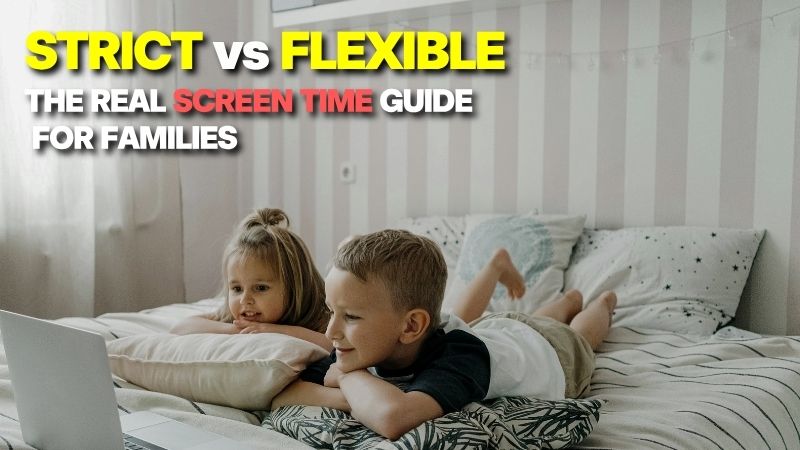
If you are raising a little one and wondering about screen time for toddlers and preschoolers in Canada and the US, you are definitely not alone 😊
As a mom in Canada, I would say I lean toward the stricter side. I usually keep my child’s screen time to a small window, around 30 minutes to 1 hour at most. Because my child is learning three languages, I try to prioritize conversation, read-aloud time, hands-on activities, and simple toys instead of letting a screen do the teaching.
I am not saying this to judge other parents. I know how easy it is, especially on exhausting days, to hand a child a tablet and let them watch “just a little longer.” But when that becomes the default, it is worth asking a bigger question: what is the screen replacing? Is it replacing sleep, play, conversation, books, boredom, or the chance to learn how to wait?
The Quick Answer
The official advice from Canada and the US is actually more similar than many parents think. The Canadian Paediatric Society says screen time for children younger than 2 is not recommended apart from video-chatting, and for children ages 2 to 5, routine or sedentary screen time should be limited to about 1 hour or less per day. The Public Health Agency of Canada gives the same basic limit for regular screen use.
In the US, the American Academy of Pediatrics discourages screen media other than video-chatting for children under 18 months and recommends co-viewing, media-free times, and a clear family plan for older preschoolers. The World Health Organization also says sedentary screen time for children under 5 should be no more than 1 hour, and less is better.
So if you want the simplest possible version, here it is: for toddlers and preschoolers, less is better, quality matters, and screens should never crowd out sleep, books, movement, and real conversation. Canada tends to sound a little more direct about the daily number, while US guidance puts extra emphasis on content quality, co-viewing, and family routines.
Why I Am a Stricter Screen Time Mom
Personally, I try to be careful with screens because I have seen how quickly they can become the easiest answer to every small problem. Bored in the car? Screen. Fussy before dinner? Screen. Tired after daycare? Screen. And before long, the child begins to expect constant visual stimulation.
In my own home, I try to do the opposite. Since my child is growing up with three languages, I want him to hear real voices, real back-and-forth conversation, and lots of natural repetition. I would much rather read books, do sticker activities, play with blocks, or let him use his hands with simple toys than rely on a tablet for learning. For me, this is not about being anti-tech. It is about protecting the things that matter more in early childhood.
That instinct is supported by the official guidance too. Canada’s pediatric guidance says young children learn best through live, interactive experiences with real people, and it recommends daily screen-free times for family meals and book-sharing. US pediatric guidance also says that when parents cannot actively play, supervised independent play is still more beneficial than screen media for infants and young children.
Canada vs. US Advice at a Glance
The table below summarizes the main points from Canadian and American pediatric guidance.
| Topic | Canada | United States |
|---|---|---|
| Under age 2 | No screen time recommended except video-chatting | Under 18 months: avoid screen media other than video-chatting |
| Ages 2 to 5 | About 1 hour or less per day | Limits are appropriate, with focus on co-viewing, routines, and a family plan |
| Before bedtime | Avoid screens for at least 1 hour before bed | Keep media-free routines and no devices in bedrooms |
| Family habits | Screen-free meals and book-sharing | Media-free family times and zones |
| Parent role | Model healthy use and avoid background TV | Co-view, co-play, and create a family media plan |
This is why I think parents do not need to obsess over Canada versus America as if one country has a completely different philosophy. The message is mostly the same: young children need human interaction more than screen interaction. Canada gives a clearer number. The US gives a slightly broader framework for how to use media well.
What Matters More Than the Number of Minutes
A lot of parents only ask, “How many minutes is okay?” But that is not the only question that matters.
The AAP’s 5 C’s guidance for toddlers and preschoolers encourages parents to think about the child, the content, how children calm down, what media is crowding out, and communication. That is a much more useful way to think about screen time. A calm 30 minutes of high-quality viewing with a parent is very different from endless autoplay videos that replace movement, books, or sleep. The same AAP guidance also recommends more intentional viewing habits.
Canada’s pediatric guidance makes a similar point in a different way. It recommends minimizing screen time, reducing risks, being mindful, and modeling healthy use. It also specifically warns against background TV and says families should avoid screens when not in use. Background TV has been linked with lower language use, weaker parent-child interaction, and distraction from play in children under 5.
That part really matters to me as a mom. A tablet is not always bad because of the exact number of minutes. Sometimes the real issue is that it is replacing eye contact, language, boredom, or calm-down skills. If screens are always the answer, children may get fewer chances to practice patience, creativity, and self-regulation. The AAP’s recent digital media guidance also notes that healthier rules focus on balance, content, co-viewing, and communication.
7 Realistic Family Rules That Actually Help
1. Keep Screen Time in a Small Daily Window
This is the rule I use the most. I do not let screen use stretch across the whole day. I prefer a short, predictable window instead of random screen access from morning to bedtime.
2. Protect Sleep at All Costs
The Canadian Paediatric Society recommends avoiding screens for at least 1 hour before bedtime, and the AAPrecommends media-free zones like bedrooms. If your child is wired, stalling, or sleeping later, bedtime screen habits are one of the first things to review.
3. No Screens During Meals
Meals are one of the easiest places to build language, connection, and routine. Canada specifically recommends daily screen-free times for family meals and book-sharing, and the AAP recommends media-free times together, including family dinners.
4. Choose Content Before Your Child Presses Play
Do not let the algorithm choose what your young child watches. The AAP advises parents to prefer high-quality content and to be intentional about media use.
5. Co-View Whenever Possible
If your child watches something, sit nearby when you can. Comment on what you see. Ask simple questions. The AAP and Canadian guidance both support co-viewing because it makes media more interactive and easier to manage.
6. Do Not Use Screens as the Only Calm-Down Tool
This one is hard for tired parents, and I say that with a lot of empathy. But children also need to learn other ways to cope: cuddles, music, books, a sensory bin, deep breaths, a walk, or just time beside you. The AAP’s 5 C’s framework specifically asks parents to think about how children are learning to calm themselves.
7. Let Boredom Exist
Some of the best play starts with “There is nothing to do.” Boredom can lead to pretending, building, drawing, sorting, or simply talking to you. And honestly, that is one reason I do not want screens to rush in every time my child gets restless.
What I Do at Home Instead of Handing Over a Tablet
This is the real-life part, because parenting advice only works if it can survive an ordinary messy day 😅
When I need to keep my child busy, I usually rotate a few simple things:
- picture books
- sticker books
- blocks or magnetic tiles
- coloring or water painting
- easy hands-on activities
- small pretend play toys
- music and movement
- outdoor walks, even short ones
Why do I prefer these? Because they leave room for conversation. Since my child is learning multiple languages, I want him to hear words in context, ask questions, answer back, and connect language with real life. A screen can show a color or an animal, but a real conversation goes much deeper.
This is also where I think many modern families feel tension. Tablets are convenient. They are quiet. They work fast. But convenience is not always the same as what helps young children most. Both Canadian and US pediatric guidance keep coming back to the same truth: in early childhood, children learn best from responsive relationships, active play, and routines that support sleep and development.
FAQ
Is 1 Hour of Screen Time Too Much for Toddlers or Preschoolers?
For many families, 1 hour is already the upper end of what official guidance suggests for regular use. Canada says children ages 2 to 5 should be limited to about 1 hour or less per day, and the WHO says sedentary screen time for children under 5 should be no more than 1 hour, with less being better. So if your child is getting more than that most days, it is probably worth adjusting routines.
Does Video Chat Count as Screen Time?
It is still a screen, but it is treated differently in official guidance. Canada allows an exception for video-chatting with caring adults, and US pediatric guidance also treats video-chatting differently from passive screen use.
What Is the 3-6-9-12 Rule for Screen Time?
The 3-6-9-12 rule is not the main Canadian or American official standard. For this post, the most useful references are still the official guidance from Canada, the AAP, and the WHO.
Final Thoughts for Tired Parents
If there is one thing I want parents to take from this post, it is this: you do not have to be perfect to be intentional 🌿
Some days are long. Some days are rainy. Some days you are sick, overwhelmed, or simply trying to get dinner on the table. A little screen time does not make you a bad parent. But it is still worth protecting the bigger picture.
For me, that bigger picture is simple: I want my child to talk more, play more, touch more, imagine more, and depend a little less on a screen to stay regulated. And when I look at the official advice on screen time for toddlers and preschoolers, that is exactly where it points: less passive screen use, more real-life interaction, and clearer family habits that children can trust.
Read next :
- Screen Time Before Bed in 5-Year-Olds: How It Affects Sleep
- Background TV and Child Development: Hidden Effects Parents Miss
- Multilingual Kids: 7 Future Advantages Parents Should Know